Showing posts with label memory. Show all posts

Sunday, 20 April 2014

Can I be that little bit better at.....designing a better GCSE curriculum? Part 1

I've been a GCSE teacher for a number of years now.  In that time I have seen the curriculum we deliver evolve into various forms that serve our students as best as possible at that particular time.  If I remember back to the first few years of my teaching where I was under the guidance of a very good former Head of Department, we had the whole two years mapped out into organised blocks which easily kept me up to date and on track.  At any point in the course I could readily tell you where we were and what was coming up.  The structure was regimented and ensured we reached the end of the course fully prepped for the exam.  There were some draw backs though.  Every lesson was accompanied with a worksheet which students filled in.  It wasn't that inspiring but did ensure that the theory element remained a strength of the department.


Over the years the curriculum changed.  The department began to move away from the worksheets and began using exercise books.  There was more freedom in the classroom for teachers to teach how they felt best supported their students.  We still remained on track and on target but not for the reasons you may think.  During this transition something had gone missing.  We no longer had a curriculum overview.  We seem to have forgotten to design schemes of work.  The experienced teachers in the department simply used their expertise and excellent team ethic to collaborate and deliver lessons in an order, working around deadlines and ensuring we fulfilled the course requirements to as high a standard as possible.  We still had a rough plan and knew what we needed to teach and in what order but nothing was formally written down.


The aim
Now don't get me wrong, we know this wasn't ideal but it just seemed to work.  The theory element of our results has always been above national average and our students seemed to succeed.  However, over the last year we have worked hard to address the oversight and implement a new structure.  Working with the amazing Fran Bennett (seriously, she is an exceptional teacher and colleague!) we have tried to design a curriculum for our GCSE course that builds upon the great practice going on so far.  The aim of this process was to design a curriculum that both promoted a very high standard of learning, as well as ensuring students remembered this knowledge over time.  

Leading into this I had been reading more and more into the field of cognitive science/psychology.  What I read built upon previous work I had come across in my own education (Anderson, Schmidt, Thorndike etc).  As part of the core foundation to the new curriculum, we would look to implement elements of research into our planning.  These would notably come from the work of Curran, Willingham and Bjork.  Could we design a curriculum in such a way that students could retain their learning for longer and also reduce the need for intervention in the mad rush that is exam season?


We also looked very hard at what matters in our subject and identified areas that should be a priority.  Taking into account what the specification and exam requires is one point, but we also looked at other components that could truly benefit learning.  We didn't want the curriculum to be too rigid and monotonous.  Instead we wanted it rich with information, meaning and context.  We looked to use articles, case studies, real world experts and so on.  The principles needed to be tight but the day to day use of them needed to allow teachers freedom.  The structure and logistics of the curriculum are also built on some key fundamental principles revolving around improved levels of writing, refined feedback opportunities, and enhanced levels of challenge.  All of these were based on previous ideas, practice, experience and research, and allowed us to raise the level of our subject much higher.

With all of these things in mind, could we be a little bit better at designing a better GCSE curriculum than we previously had?

The bigger picture - The curriculum overview
It would be wise to point out that at this stage the overview is a work in progress.  We decided to focus solely on redesigning our Year 9 to Year 10 theory course (omitting Year 11 for the time being).  This was due purely to the fact that we needed to be able to plan, run and then evaluate the impact of our ideas before rolling it out further.  If it was having a negative effect on outcomes then we would still have Year 11 to amend it.  We also wanted to make the course manageable and by designing it slowly and carefully we would ensure that what we were putting into play would be consistent.

As I stated earlier, we have been looking at particular components of effective teaching over the year.  The process forced us to undertake a lot of reading of research articles and focus more on evidenced based practice.  There were a number of findings that I will explain over a few posts that really challenged our thinking and pushed us into some fantastic discussions.  In this post I will talk about how we went about implementing five key findings from the world of cognitive science/psychology into our curriculum design.

Implementing cognitive science principles
Experience over the years has shown me that when students reach the end of our course they seem to have forgotten chunks of it.  Gaps in their knowledge emerge and worry starts to set in.  It seems that although we taught them the specific content knowledge they need for each topic, it has somehow become very hard for them to access it.  All of the results, data and anecdotal evidence at that particular time seemed to have indicated that students knew that information a year ago.  The problem is that a year down the line and this is no longer the case.  So is this performance or learning?


The way we taught our GCSE course meant that students performed very well during immediate questioning, discussions or testing.  What didn't seem to happen though is the ability to remember this information later on in the year, or possibly towards the end of the course.  Now there are obviously some students who seem to understand and remember everything, but there is still a strong majority who forget information that we were certain was concrete.  Some would remember things when prompted, but there were still a number who had forgotten things taught nearly two years before.

After a lot of reading of research articles and publications (summarised here), we were not surprised to find that although a lot of our teaching was effective in the short term, there were a number of 'tweaks' that we could make to ensure learning lasted over time.  We began to analyse what we could realistically implement into our first trial of this new curriculum.  Discussions focused around the ideas of 'Desirable Difficulties' from Bjork and general cognitive science principles from Willingham.  So what did we do?  What were the cognitive science/psychology principles we looked at designing our curriculum around?


1 - Ordering our units

A number of researchers have stated the point that knowing things makes it easier to learn new things (apologies for the oversimplification of this).  In designing our new curriculum we built upon work that had been done previously in the department and ensured the order of units made sense.  We aimed to logistically place units in an order that built upon the previous units’ information.  For example, in Unit 4 we study ‘Physical and Mental Demands of Performance’.  The unit covers topics focusing around the various physiological systems in the body, as well as some psychological factors as well.  As an example, during this topic, when students learn about the aerobic/anaerobic energy systems, they can draw upon previous knowledge to help them.  Unit 1 information can help them understand why each individuals system may vary due to age, physique and so on.  Unit 2 can help them see why different types of athletes may have time to train or even monitor these systems.  Unit 3 may help understand the various training methods that are required to improve either the aerobic or anaerobic system.  The stream of knowledge links.

The aim we tried to incorporate was to build upon prior knowledge so logically ordering what is taught first so it snowballs and draws upon old information.  Building upon prior knowledge and learnt information makes learning new topics easier.  This is down to the fact that new knowledge being processed in the working memory retrieves and builds upon the older information in the long term memory to form new connections. 


The ordering also allowed us to tell the story of sport and create a bigger picture.  Obviously sport is a very complex domain with a number of interlinking points but we can at least structure the learning so that it follows an order and makes more sense to students.  The curriculum began with individuals, followed by how they are perceived, how they raise their performance to succeed and finally what physiological changes happen during this.  This makes it much easier for students to process this information in a methodical way (and potentially helping reduce the impact on the working memory and cognitive overload).


2 - Interleaving 

I won’t go into detail about the theory of interleaving as I have written about it here.  It is sufficient to say that cognitive scientists like Willingham and Bjork both agree that if students are to remember a particular piece of information, they will need to revisit it numerous times throughout the course.  Traditionally we had followed a method that is referred to as blocking.  We would select a unit, teach it, test for understanding and then move onto the next unit.  This provided us an accurate account of what students knew at that point.  What we had done though is compartmentalised learning.  We had isolated groups of topics into blocks.  In the short term, student performance looked good.  In the long term, the result of this is that due to our GCSE starting in May during Year 9, students in Year 11 struggled to remember back to information from two years ago.  We had not consciously made attempts to recap topics from earlier points of the course.  Therefore we can’t be surprised when students forget things.  Now obviously the more experienced teachers could make these references when needed, but this was on an ad hoc basis and we needed to ensure this was done with more thought.


Bjork proposes interleaving as one of the desirable difficulties that may overcome this.  The idea is that topics are repeated throughout the course so students are forced to constantly retrieve information.  In its most effective form it may include regularly switching topics and revisiting them repeatedly throughout learning.  An example might be spending time teaching diet in sport, then next lesson focusing on physique, then focusing on gender and then coming back to diet and so forth.  This also allows students to identify links between topics and compare information.


In reality though, when we looked at designing the curriculum this way we found it extremely difficult.   I mapped out (using a spread sheet) all of the topics that we taught, and then attempted to break up their order so they became constantly repeated.  I also tried to space them effectively so that forgetting came into play.  Working with this system became very confusing and meant that we would run out of curriculum time very quickly.  It is definitely something I will be working on next year within individual units.  Instead, we have tried hard to tie topics back into new learning so that students have to retrieve that knowledge and in return increase storage/retrieval strength.  For instance, in Unit 4 during the Circulatory system lesson, we have mapped it out that teachers tie in the Unit 2 topic of ICT in sport looking at measuring heart rate and training zones.  These opportunities are no longer left to chance and are mapped throughout the entire course.  We now have students retrieving various topics at relevant times throughout the course.


A look at Unit 2 and how it interleaves topics from Unit 1

I know it's not mathematically accurate and the spacing gaps aren't as precise as we would like, but it's hard in reality to transfer the best principles from research into practice.

3 – Spacing it out

You may have noticed in the point above that I have mentioned spacing.  I explain more about spacing here but it is basically revisiting information at spaced out times throughout a given period.  As Bjork explains:
"It is common sense that when we want to learn information, we study that information multiple times.  The schedules by which we space repetitions can make a huge difference, however, in how well we learn and retain information we study.  The spacing effect is the finding that information that is presented repeatedly over spaced intervals is learned much better than information that is repeated without intervals (i.e., massed presentation)"

Bjork also explains that the gaps between revisiting this information is also very important.  He suggests that each time we revisit it, the subsequent gap before the next time should increase, and then increase again and so on.  The aim it to allow students to almost forget the information.  When they come to retrieve it again the strength of it in your long term memory increases.


Ebbinghaus, 1885 - Note the increasing gaps between reviews and the decreased rate of forgetting.

As I have explained through the process of interleaving, it was really hard to space topics with the idea of increasing the spacing between retrieval.  How do I know when students are about to forget something so I can then refer to it?  With the spread sheet in hand I again tried to map out increasing gaps over the year.  Again I found that we would run out of curriculum time in only a few terms.  Instead we decided to group topics together in their units rather than individually.  We also used the natural roll out of the curriculum to increase spacing.  For instance, in Unit 1 we mapped out times you would recover Unit 1 topics.  When you get to Unit 2, you would have to revisit Unit 1 and Unit 2 information.  When you go all of the way to Unit 4, you would have to cover Unit 1, Unit 2 and Unit 3 information again.  Because there are more units to revisit, the gap between covering them again increases as well.


4 – Testing that is low stakes but high impact

Traditionally I have not been a great lover of testing.  It would be an option when needed but I didn’t see the full benefit that it has on learning.  Through the various readings we found that the use of tests actually is a key factor in helping information to be stored in the memory.  The process of having to retrieve information through a form of testing makes it more recallable in the future.  We also found that frequent testing has more beneficial effects than subsequent restudying of a topic.  In fact Roediger and Karpicke (2006) found that in one study, students remembered 61% of information from repeated retesting, compared to 40% from repeated study.

What we didn't want to do though is create lessons of monotony with lessons crammed with exam question after exam question.  Instead we created opportunities and methods of testing throughout the curriculum with various levels of pressure.  We therefore designed these four opportunities:
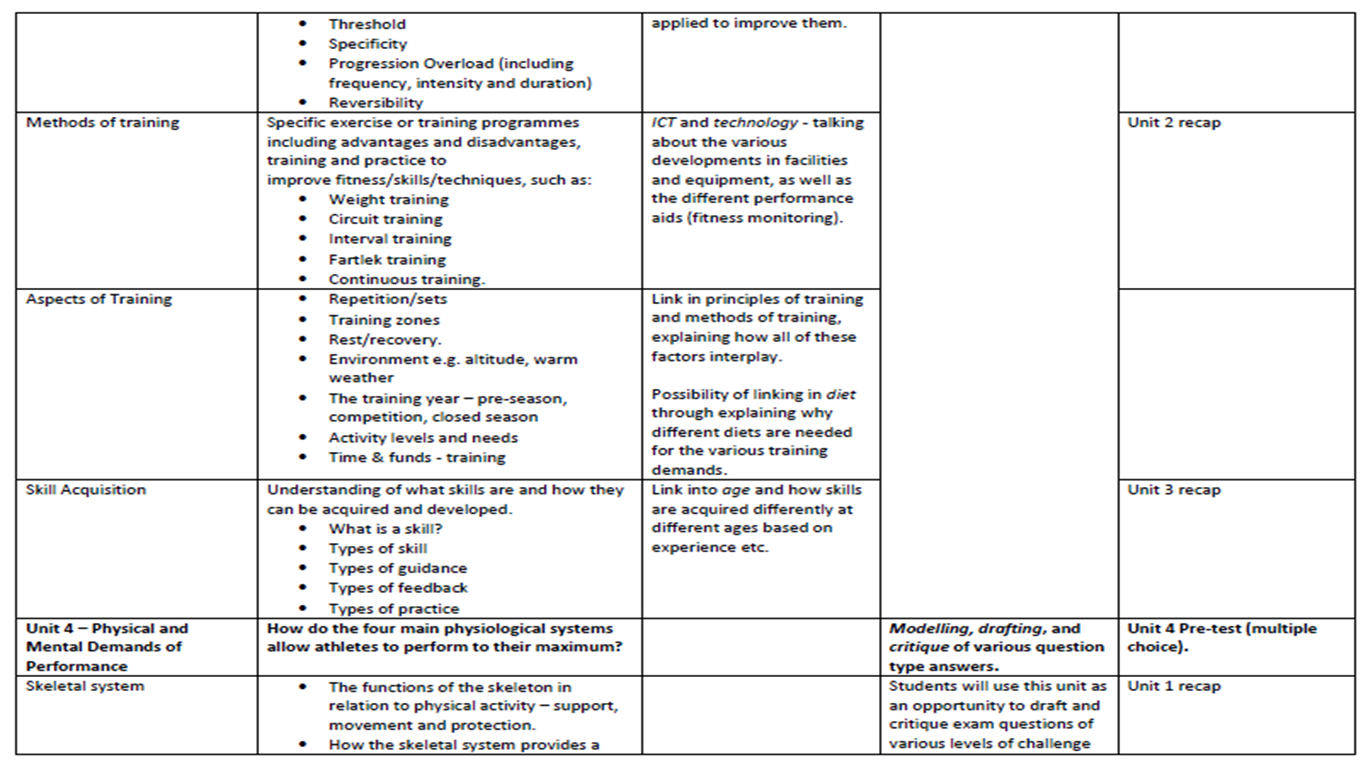

Note how in Unit 3 and 4 there are designated times for Unit recap tests.


Low stakes testing - In the testing column on the overview we spaced out (with increasing gaps) times when we ask our teachers to test old topics.  These tests are low stakes tests but force students to retrieve information.  We created a list of ideas including ‘Write down as many things as you can about topic x’ or ‘Challenge your partner, who can remember the most keywords from Unit Y’ to ‘Mindmap/Spider diagram all the links between topic A and B’.  The guidance we gave teachers is that these tests must be done in the allocated lessons and must last no longer than 5-10 minutes.  They can be done as bell work, a starter activity or even at the end of a lesson.  Providing answers should be quick and would be better if they could be done simply on one Power Point slide.  Students are now used to them as a sportsmen/women, enjoy the challenge and friendly competition.


Unit tests – Originally with our blocking of units, we would follow up learning with an end of unit test.  That test would purely focus on information from what has just been taught.  So in a Unit 4 test you would only see questions on topics from Unit 4.  This year we are including any question from any previously taught unit.  So in a Unit 3 test, you will now see questions from Unit 1, 2 and 3.  Teachers can formatively gather a sense of how well that unit has been learnt throughout lessons, but now also summatively see how they are doing within the full course.  Doing this allowed us to get students to retrieve old information and again increase its strength.

Multiple choice – Bjork’s work made reference to the benefits of multiple choice questions as a way of building up memory strength.  We now use an increased number of multiple choice questions throughout the curriculum.  In lessons we use hinge questions as one method on a regular basis.  We do this because if they are carefully crafted, the process that students take to work out correct and incorrect responses helps improve retention.  What we do with these though is follow up responses.  It could be easy for a student to simply indicate an answer with no thought.  We therefore create discussions or opportunities for students to verbalise their answer, even if it is incorrect.

Pre-tests – Based on Bjork’s work we now run pre-tests at the very start of each unit.  These take the form of multiple choice and last no longer than 10 minutes so curriculum time lost is very minimal.  The process provides cues and is thought to improve subsequent learning.  It also helps teachers gain a very quick insight into students prior understanding.


5 – Problem solving


In the first chapter in ‘Why Don’t Students Like School? Willingham explains that the brain spends a lot of this time helping us not to think.  Instead it prefers to do things automatically.  But, Willingham states that it does like to solve problems.  It is naturally curious.  It doesn't necessarily mean questions but we found this quite effective for us.  We therefore ensured that during each unit we mapped out larger driving questions.  For instance, in Unit 3, students were presented with the thought:
 “What factors do athletes need to focus on in order to reach and maintain a suitable fitness level for their sport?”

This was shared in the first lesson and everything that we subsequently learned built up a stronger ability to answer that question.  The question also allows us to tell a story about particular aspects of sport and make the various connections between topics.


To finish

What we haven’t done is created a robotic curriculum design.  We aren't constricted by what we have read or learnt.  The field of cognitive science is still not totally certain about all of its claims.  What we have simply done is taken the opportunity to use research to embed 5 simple principles that may help improve longer term retention of information.  Many of these changes are at the overview level so don’t put pressure on teachers to teach differently or in a set way.  It has simply allowed us to logistically map out key points throughout the year which we can focus on building memory strength.  There are no tips or tricks being used in lessons (unless staff wish to do so).  Instead we are using cognitive approaches to work hand in hand with learning to make it longer lasting.

In the next post I will look at how we designed our curriculum to improve levels of writing, the impact of feedback and the levels of stretch and challenge (with an A level twist!).

Thursday, 5 September 2013

Can I be that little better at……using cognitive science/psychology/neurology to plan learning?


In my last post I talked about how a number of factors throughout an academic year can help inform what you plan, how you plan it, and ultimately why you would plan it that way.  It took into account a lot of experience, trials, research and an underlying understanding of teaching.  In this post, I look at how knowing a little bit about cognitive science, psychology and neurology can affect the way in which you plan learning.  It’s always interested me how something I teach students’ one day can be forgotten only a few days later.  How is it that something I was so confident was memorised (or learnt) by students seems to vanish so quickly.  And that will be the underlying theme running through the posts.  How can we actually (or as best as we can) get the stuff we teach learnt in a way that students will remember it for a long time to come?  Now I may be speaking out of turn, but knowing how to make things 'stick' so that they can be retrieved at a later date, and methods we can plan into our lessons to do this, should at least cross our mind when putting a plan together.  You may not do anything out of the ordinary, but understanding how the brain works (that is if we actually really know how it works?) could help make what we plan to do to, and how we plan to do it, be that little bit more effective.  But first, here’s a summary of three background pieces of information you should be aware of:

It’s all a bit…..chemical-ly?
In a short sweet summary, the brain creates memories or templates through the release of various chemicals in the brain.  The two main ones are glutamate and dopamine.  Dopamine is the chemical that as teachers we want students’ brains to be releasing to ensure what we are teaching actually sticks.  It’s essential for making templates and connecting neurones to have this present in learning.  But how?  Well dopamine is predominantly released in two ways.  One of them is stress.  Although stress releases dopamine, it actually floods the brain and causes future problems.  It releases other chemicals that inhibit learning and actually affect the areas concerned with memory.  A more appropriate way is through reward and anticipation of reward (Curran, 2008).  As a teacher this can be created by the level of challenge and the way we involve students in learning.  I’ll talk about it a little later.  The main message here though is that if we create a highly stressful environment for students, we shouldn’t be surprised if things don’t stay in students memories for long.


The brain has a working memory, and it’s a really important part if we want things to stick.
In essence, when students are learning in your classroom they initially use their working memory to process and filter what it is you are teaching them.  The working memory however has limited space and can get very crowded very quickly.  It can also get filled up with distractions or irrelevant information which is why students sometimes misunderstand or can't remember things.

"Working memory is the workspace in which thought occurs, but the space is limited, and if it gets crowded, we lose track of what we're doing and thinking fails" 

(D.T.Willingham Why Don't Students Like School) 

Now the working memory deals with the ‘here and now’.  It’s what students use when forming an understanding as we teach them or explain something.  Information resides in here as students make meanings or develop understanding.  When the conditions are right, this information can then be transferred to the long term memory.


Working memory is a key player in getting information into our long term memory
Daniel T. Willingham in his book Why Don’t Students Like School? explains that working memory and long term memory work hand in hand with each other.  When the working memory is dealing with new information, it calls upon the long term memory for relevant background information to help make sense of it.  Once the working memory has thought about it, understood it and made meaning of it, there is a good chance that this information is committed to the long term memory.  This is a very basic analogy and isn’t as simple as it sounds.  If it were, students’ would remember a lot more than they already do.  But they key message here is that information needs to be attended to in the working memory otherwise there is little chance of a lasting memory ever happening. 

So how do we do this?


1 - The working memory is limited in space though so we need to consider this in our planning.
It is therefore really important in planning to ensure that when an element of learning is taking place, we don't over complicate it or create unnecessary distractions.  Ensuring that the attention of the student is purely on the learning is something that should be considered when planning.  Will the example you give or the task you design actually alter the students focus elsewhere and away from the topic in hand?  Nuthall in his book discusses how students’ recollection of information can be affected by the type of activity we design.  He states “sometimes memory for the task itself is longer lasting than the content the task was designed to teach”.  Willingham also gives a great example in his book where a teacher creates a task that resulted in students creating PowerPoint presentations.  Sounds normal yes?  The point he raises though is many students focused on the quality of the PowerPoint (the animations, fonts, pictures) and focused very little on the content they were learning.  Obviously the level of learning and what could be remembered about the topic at a later date wasn't very high.  That isn't to say though that we give up using variety and being creative in lessons (because this is an important part of remembering which I will talk about later), but the suggestion is to work on the content first, refine it, learn it and plan it before putting it into a new context (a poster, presentation, leaflet).  Therefore the learning in lessons, and time to create drafts, will need time carefully planned into it and come prior to starting such activities.  Getting students to think about, analyse and design what goes into a presentation before they hit the computers is a consideration that should be taken on board.


2 - Knowing things makes it easier to learn new things
Ok that again is a bit simplistic but the constant theme coming through Nuthall, Willingham and the work of Bjork is that having prior knowledge helps understand new knowledge much easier (although Nuthall does go on to say that if students of different abilities have the same learning experience they will learn just as much as each other).  It is though very difficult to know how much prior knowledge each individual has.  In my last post I talked about the importance of knowing the prior attainment of your group and using this to inform future planning.  But this is normally in the form of data and doesn’t tell you what they really know.  There is the possibility of planning in pre-tests or other introductory activities but maybe we could make the initial planning that little bit simpler.  One consideration is the careful planning of what is taught first and the sequences/pathways that follow.  The tip is to build upon prior knowledge so logically ordering what is taught first so it snowballs and draws upon old information can easily be mapped out before starting a unit.  Building upon prior knowledge and learnt information makes learning new topics easier.  This is down to the fact that new knowledge retrieves and builds upon the older information to form new connections.  The order doesn't have to be linear though and by using hooks, larger questions or starting with a broader concept, we can start with a wider idea which we can begin to learn about.  So is there a logical order in your subject?  Is there something that is vital to know first?  


3 - We can make using the working memory more efficient
This is more of a rationale rather than a tip.  As my earlier quote from Willingham explains, if there is too much going on in the working memory, students can lose sight of what is going on and the process fails.  Although there are no known ways to improve working memory, there is advice to using it more efficiently.  If working memory has a limited space, crowding it with numerous pieces of information can make the learning more difficult and less likely to be remembered (as I touched upon above).  A lot of new information we learn is done so by combining or linking to existing understanding or background knowledge.  By making what you teach more likely to be stored in the long term memory, it is easier to retrieve it again in future when you need it and is more space efficient (for the working memory) when doing so.  It therefore makes learning new information more achievable, especially when you need already learnt information (background knowledge) to do so.  So planning to commit as much information as possible through these suggestions can make the learning of new information easier.  Makes sense to me.


4 - It will only stick if you think about it
Willingham in his book talks about the importance of getting students to think about the knowledge they are paying attention to.  He explains that “your memory is not a product of what you want to remember or what you try to remember; it's a product of what you think about”.  It is therefore important we take his tip and “review each lesson plan in terms of what the student is likely to think about”.  If we are to help commit what we are teaching to students’ memory to be recalled later, we need to ensure the level of thinking is high throughout.  Unfortunately, many a lesson in my early career rarely had students thinking hard about anything at all.  Should I have been surprised when test scores weren't great?  So the step forward (in my case using SOLO taxonomy) is to constantly check planning before hand to evaluate the quality and depth of thinking that progresses through the lesson.  Am I hitting the surface and background information at the right times to build up background knowledge, and then working with it at a higher level later on to compare, evaluate, analyse and predict?  Willingham also talks about the fact that it's not just the level of thinking taking place, but the making meaning of what is being thought about.  Are the activities we have planned to use actually the most effective to help them understand what the information means?  This involves clever task design to ensure this happens.  The use of concept maps, challenge, well thought out questions and carefully planned tasks need to become part and parcel of what I do.  So, if the lesson I have planned doesn't make students think, or even understand the meaning of what is being taught, then it's back to the drawing board!   


5 – Pitching it right
As I said earlier on, the challenge that students are faced with when learning can help improve the likelihood of longer lasting memories to be formed.  Willingham talks about solving problems (in a wider sense) and engaging students in cognitive work.  If students aren't actually thinking and making meaning then it won’t be learnt.  He also warns that “without some attention, a lesson plan can become a long string of teacher explanations, with little opportunity for students to solve problems”.  So reviewing how challenging the lesson will be is again a really important point.  Have you pitched the work right?  Is there too little opportunity for students’ to think and be challenged? 

And then there's the neurology side (as highlighted by A. Curran). If I want to get the brain cells firing I also need to go back to the fact that the level of challenge needs to be pitched adequately in order to create an emotional response (emotion improves what is remembered).  In a very (and I mean very) basic summary, to learn new things we need chemical reactions involving the release of dopamine to be present.  Dopamine is normally released when a reward is present.  The emotion and reward of learning, and resultant dopamine release, is essential to commit knowledge to the long term memory.  It's the chemical which binds the neurones together to create memory so is essential I help (if I can) to get them firing and dopamine released.  Pitching a task too easy creates no real reward.  Why would it?  There simply isn't a reason for that feel good feeling to happen.  On the flip side, creating a task so difficult and without clear steps to achieving it students feel helpless and see it is not achievable is also not conducive (but don't make the task easier, make the thinking around it easier).  Again, knowing your group and planning to push individuals to create new meanings is another sure fire way to commit information to the long term memory.  Planning to get that dopamine release isn't going to be easy, but pitching challenge is surely the way forward.


6 – Three is the magic number
In his research that focused on how students actually learned in classrooms, Nuthall found that students who were exposed to a new concept on three different occasions and in a variety of experiences, stored the information in their memories for longer.  He states that:

“We discovered that a student needed to encounter, on at least three different occasions, the complete set of the information that she or he needed to understand a concept.  If the information was incomplete, or not experienced on three different occasions, the student did not learn the concept.”

Now using this principle, Nuthall was able to successfully predict what students would learn/remember with an accuracy of 80-85%.  An important warning though is that simple repetition will not be sufficient.  The three different experiences must come in a variety of mediums and ways.  Variety is therefore the key.  He also stresses that one great explanation is not enough.  So why three times?  Well he explains that new concepts aren’t transferred from the working memory into the long term memory until enough information has been accumulated to warrant it to make the move.  Students need to have sufficient understanding, knowledge of meaning and be able to link it to prior knowledge.  So in planning out a topic, will students really encounter a concept a minimum of three times each in their own varied way?  If not, this may also be a reason for things not sticking.


7 – If you don’t use it you lose it
This is a saying that I have heard for many years but is not quite right.  It's true that things become harder to remember as Willingham states when he says "we forget much (but not all) of what we have learned, and the forgetting is rapid".  Bjork (who I will introduce in a moment) along with Curran explain that it’s not a case that previously well learnt information we haven’t thought about is simply removed from memory.  They say it is not as simple as that.  Obviously our long term memory doesn't have an infinite capacity (do we really even know how much it has?), but one thing is for sure, if we don’t get students to revisit things, the connections or ‘route’ to them becomes weaker and more difficult.  Bjork talks about the fact that these things simply become harder to retrieve.  In some of the work by Bjork, subjects struggled to remember information they had learned a long time ago.  When presented with possible answers or cues, they suddenly remembered.  It wasn’t that the information was lost.  It was just harder to find or retrieve and the prompts help with the process.  So how can we ensure that we can help students learn something so that it is accessible a long way down the line (like during the exams period?).  As point 8 states, ione consideration could be ‘Practice, practice, practice’.


Interlude – Intro to Bjork
I thought it might be beneficial to stop for a moment and explain a little bit about Robert Bjork.  Some of what I will now talk about use slightly different terminology and I wouldn’t want to confuse examples.  One of the things that has got me most excited is the work of Robert Bjork, the Cognitive Psychologist from UCLA.  He poses some VERY clear considerations of how to tweak planning to improve long term memory.  Much of his work is not just applicable to the planning of lessons, but is also very important to long term planning of schemes, units or whole courses.

Bjork's work ties in with Willingham's research in a number of places.  Bjork talks a lot about long term memory and the fact that what goes in there is dependent on two indices: its storage strength (SS) or its retrieval strength (RS).  He talks very clearly about the importance of creating an environment where any new information is done so in a way that SS and RS is high.  Designing lessons where both (or even one of them) are low, could make remembering this information very difficult.  So what are these two elements and how to they link with planning?
Storage strength - 'How well learned something is'.  It makes perfect sense that learning something in depth increases the chance that it will be stored in the long term memory.  The better it is learnt the greater the storage strength.  If it has high storage strength, it is pretty likely that it will be stored in the long term memory ready to be 'retrieved' at a later date.


Retrieval strength - 'How accessible (or retrievable) something is'.  In very simple terms, retrieval strength works a little like this: The better you learn something, the higher the storage strength, the higher the retrieval strength.  Retrieval strength is your ability to recall, or retrieve, information at a later date.  Now retrieval strength decreases over time which is why a few months or years down the line we find it difficult to remember something even though it is on the tip of your tongue.  If something only has a low storage strength it will decrease quicker than something which you have learned well and ultimately has a high storage strength.  Obvious to say then that if you want to remember something a long way down the road, you need to ensure what you learn is high in both SS and RS.

But what implications will this have on my teaching?  How can I plan to have both of these?  Well Bjork identified a number of conditions which over time increase the chances of high SS and RS - which in turn leads to information being retained for much longer.  Now Bjork warns that these principles “slow down the apparent learning, but under most circumstances help long term retention, and help transfer of knowledge, from what you learnt to new situations”.  He dubbed these conditions desirable difficulties.  These conditions are purposely difficult and challenging to the students and assist in long term learning.  Whether you see 'rapid and sustained progress' in 25 minutes is unlikely.  But short term effects are not the goal here (and neither is it mine).  So how does Bjork’s work tie in with the others?  Let’s get back to the tips.


8 – Spacing it out (carefully mapping out practice, practice, practice).
Willingham and Bjork both have similarities in a lot of their work.  Willingham talks about the need revisit work and states “It is virtually impossible to become proficient at a mental task without extended practice”.  It is important then that things we want to stay retrievable in the long term memory need to be engrained in it adequately.  Practicing and repeated learning of a task can help make that information stick.  It also makes it more accessible in the long term memory and this helps new learning and the function of the working memory more efficient.  We therefore need to ensure that repeated practice is planned out throughout the year to ensure that a topic is revisited.  A way to do this (as agreed by both Willingham and Bjork) is space out learning and times when we come back to a topic.  As Bjork explains:

“It is common sense that when we want to learn information, we study that information multiple times. The schedules by which we space repetitions can make a huge difference, however, in how well we learn and retain information we study. The spacing effect is the finding that information that is presented repeatedly over spaced intervals is learned much better than information that is repeated without intervals (i.e., massed presentation).'”

In numerous studies in this field, Bjork and other researchers have found that the revisiting a topic multiple times over an extended period has a huge impact on the long term learning.  Obvious hey? But do we always plan to do this?  Bjork explains that by spacing out the intervals between revisiting a topic, we are encouraging the retrieval strength to decrease (The new theory of disuse - Bjork & Bjork 1992).  He also promotes that we plan to have the duration between intervals increases each time as well.  But why do this?  Research showed that information with a high storage strength, which was allowed to lower in retrieval strength over time, actually improves the subsequent learning of it when revisited.  The brain stores this information much better the second, third, forth time round and improves the retrieval strength as it goes.  The act of trying to remember what we almost forget is a good thing for memory.  Therefore planning to revisit topics and working out an optimal gap between revisiting it (increasing in length each time so it is almost forgotten) can have a very high effect on the long term learning of it.  From a planning perspective, it is therefore vital that topics are mapped out through units and schemes, with opportunities for them to be revisited or recapped.  Although this may seem time consuming to plan, or logistically a bit of a headache, the long term benefits can be far greater than simply blocking topics together (massing practice which ultimately results in very poor retention and retrieval strength) which is something we, and a lot of other schools, currently do.


9 – Interleaving
Now if I spaced and revisited topics from a course using the previous idea, you might quickly realise that you would run out of available time in your curriculum.  A way to ensure that spacing is done more efficiently is to weave numerous topics together throughout the year.  An example of this may be linking a topic I cover at the start of the year, say gender in sport, with a topic I teach a few months later, sponsorship in sport.  This process is called interleaving and requires the learner to constantly reload information from the long term memory.  A more extreme version of this may be to teach gender in sport, then age in sport, then diet in sport and so on, until finally returning to recover gender in sport, age in sport......etc.  As you can see, this could be logistically impossible with the time constraints of a 2 year GCSE course.  At a first time of trying this very different approach it could also be perplexing for students.  Instead, using the principle of spacing, combined with my initial example of interleaving, can result in a very exciting programme of study.  It steps away from the blocking of topics (massing practice) and allows for retrieval and storage strength to be increased.  It also allows juxtaposition of various topics and deepens understanding.  Planning out the course more effectively using this principle can be easily done.  The use of SOLO taxonomy in my personal lesson design also assists the achieving of this.  It does require careful mapping out, but reworking schemes this way ensures SS and RS increase.  A winner for long term learning.


10 – The testing effect

“Taking a test often does more than assess knowledge; tests can also provide opportunities for learning. When information is successfully retrieved from memory, its representation in memory is changed such that it becomes more recallable in the future and this improvement is often greater than the benefit resulting from additional study.”

Being asked to retrieve information alters your memory so information becomes more re-callable in the future.  Bjork identified testing as a method that can help make this happen.  This isn't testing purely for assessment though, although it can serve both purposes if needed.  The process of testing allows the connections towards that piece of information to strengthen, and therefore be easier to access than other methods.  It can be done in a number of ways.  Here are three which I will be planning to use over the year:

If we start in a logical order, Bjork found that testing prior to a topic or unit can has an improved resulting effect to long term learning.  This is an easy enough task to put in place and can be planned for at the start of any new topic.  “Although pretest performance is poor (because students have not been exposed to the relevant information prior to testing), pretests appear to be beneficial for subsequent learning (e.g., Kornell, Hays, & R. A. Bjork, 2009).”  It in itself provides cues for the then to be learnt information which makes it more learnable.

Using testing within lessons is also an effective method to increase long term learning.  As stated earlier, the process forces the brain to retrieve information from long term memory and can make future retrieval quicker.  It's effect can be very powerful (in one study students remembered 61% of information from repeated testing compared to 40% from repeated study - Henry L. Roediger, III, and Jeffrey D. Karpicke).  Adding tests as a starter, mid lesson activity or even plenary are very easy to organise and implement.  But what type of tests are best?  Although there are no sure fire answers, Bjork found the use of multiple choice tests to have a higher effect.  As Bjork explains “Little and E. L. Bjork (2010) argue that when students do not know the answer to a multiple-choice question, they may try to retrieve information pertaining to why the other answers are incorrect in order to reject them and choose the correct answer. It is this type of processing leads to the spontaneous recall of information pertaining to those incorrect alternatives, thus leading the multiple-choice test to serve as a learning event for both the tested and untested information.”  Therefore the use of multiple choice and working out the various options, helps improve the retrieval strength and subsequent long term retention.

Finally, Bjork identified that using tests and quizzes with students and their peers is a much better way of ingraining information to the long term memory than simply hitting the books.  I personally have already found this an outstanding revision tool as explained in an earlier post here.  Using testing as a desirable difficulty in the revision season can again increase retrieval strength.


11 - Final consideration: Mnemonics and other ‘tricks’ can help

Something we covered with students in our Learning to Learn course where simple memory tricks to help students remember information.  Now if there is information to be learnt, which requires little thought or seem meaningless together, a way to remember them is to use mnemonics or acronyms.  Because these pieces of information need to simply ‘be known’ in order to progress onto future learning, the use of these strategies can be very helpful in these instances.  So as Willingham explains, we shouldn’t be afraid to use them when suitable.  The same can be said for approaches like chunking.  If you don’t know what it is, it’s a method by memorising information by grouping things by association.  An example might be by remembering all of the fruit, then the stationary, and then the sports equipment from a long list of words.  The working memory works better when it isn’t overloaded.  By chunking numerous topics, this counts as one piece of information in the working memory, not several individual pieces.  It therefore makes for an effective, and efficient, quick little method to share in class.

If we believe what these principles say, by focusing on the way we plan in a slightly different way, we could be improving the chances that students learn information for the long run.  Hopefully these methods allow students retention rates to improve, rather then being forgotten only a few days, weeks or months later.

Links and further reading:

Why Don't Students Like School - Daniel T. Willingham


Wednesday, 24 April 2013

Making revision work

Over the years I have run numerous revision sessions to GCSE groups.  I have run Easter revision sessions, after-school revision sessions, online Twitter revision hours and one to one revision intervention groups.  I have taught students the benefits of revision and the process of how it happens through leading our Year 9 Learning to Learn course.  I have led revision assemblies for all Year 10's and 11's.  I have even worked with staff to develop effective revision techniques that tie in with key ideas on how the brain works and stores information.  I would be confident in saying that I believe I can run an effective revision programme that benefits students.  However, this year I have really looked at my practice and refined (and pruned) the way that I approach teaching in general.  This has allowed me to focus on what is essential in great teaching and revision is no different.  As I approached the critical 'exam prep' season, I was very concious that I wanted to do away with all of the gimmicky 'activities' that probably take twice as much time to set up but have half the impact than other simpler ideas.  I wanted to ensure that what I did had the key elements of effective learning.  Any revision session I chose to construct had to allow me the opportunity to question students, check their understanding, provide feedback and feedforward, allow them a chance to act upon any comments, make improvements to their work, practice exam technique, allow the opportunity to model good exam structure, work collaboratively whilst revising with others and force students to make an action plan of areas in their knowledge that needed addressing.

Focusing on these key elements led me to reading a number of interesting posts.  Each post highlighted a different key aspect which when combined, would allow me to create a structure to my revision session that I believed would help students.  The first of these posts came from Alex Quigly (see here) and focused on 'testing for learning' and using tests in revision which ultimately have a positive impact on learning.  The use of tests or exam drills must be teamed up with repetition and skilled feedback for students.  As Alex says, 'the act of retrieving information for a test is proven to recall more than simply restudying information'.  Using exam questions with students can be tedious, but is bread and butter in terms of preparing them for the real thing.

The second post I read was also from Alex and talked about the evidence behind revision techniques and helped me select the approach that I was going to use with my class.  The post which is an excellent read can be found here and is well worth taking a look at.  It really helped me filter out activities that had little or no impact and allowed me to focus my attention on using what works.

The next post wasn't based at all on revision but instead on effective use of feedback and how to 'close the gap'.  It is written by Tom Sherrington here and summarises his visit to Saffron Walden Community High School and the approach to feedback policies that they use.  The article got my mind thinking about how effectively I provide students with feedback and how I could implement it (especially the marking key) into my revision sessions.

The next post was from Annie Murphy Paul and can be found here.  In her article she summarises the perils of re-reading work as a revision strategy, using the work of Daniel T. Willingham as the basis of her post.  It is a very thought provoking piece of writing and one which reaffirmed my own beliefs on the subject.

The penultimate post was a one that I had used last year and inspired my to design a SOLO stations lesson.  It is written by @DVPLearning and explains an observed revision lesson where the teacher used a method called 'Teach, Do, Review'.  The full article can be found here but explains how the teacher split the class into three groups based on their competency in that particular topic, and then gave each group a different revision activity.  The method he talked about resonated with me and allowed me to provide a differentiated revision lesson that allowed students to move between tasks in order to progress or recap a topic.

The last post was tweeted out by Darren Mead and talked about a PEEL task called a 'Five out of three' activity.  A link to it can be found here.  The activity encompassed so much of the core lesson essentials (questioning, feedback, time to act upon feedback, checking content knowledge....) and was one I would definitely use in my revision programme. 

So, with all of these combined ideas, I created a 'Teach, Do, Review' lesson.  The session is designed to draw upon the key points from the blogs above and ensure that the revision that takes place is both productive and meaningful.

Teach, Do, Review (with a five out of three starting point).

It is probably important to point out at the start that this lesson was a 2 hour double theory lesson.  This allowed me to run the full process.

The starting point of the process involved me ascertaining the level of subject knowledge that student already had for my chosen topic area.  It is important to find out what students already know and what areas still need refining.  Wasting time covering a topic that students are already competent in is time not spent covering a topic that they are not.  With time a very precious thing in the exam prep period, it is important I use it efficiently.  Using Alex's advice in his post on using tests to retrieve information, I decided to use the 'Five out of three' PEEL task as the basis for this.


As students arrived I grouped them into paired teams based on their previous assessment levels.  Similar ability students based on data would therefore work together and allow me the chance to tailor my feedback to their needs.  The process of the session would be extremely simple.  Students would receive six exam questions taken from the unit topic we were covering (physiology in this case).  Students were able to choose any question to tackle first, therefore allowing them to prioritise them and create their own order.  Students worked with their partner to answer the questions one at a time.  They would not be able to use any resources (text books, note books...) at all.  Everything had to be as a result from memory retrieval.  When they had answered a question, they would hand it in for marking/feedback.


Each question varied in marks (from 1 mark all the way to 4 marks).  They are low enough for the lesson to keep pace, selected carefully enough for me to check understanding (hinge questions if you may), varied enough to cover all aspects of the content and brief enough to allow me to mark them quickly.  As the questions are marked, they receive a specific score out of three, irrespective of how many marks were on offer.  The scores were as follow:

  • 1/3 = Answer was poorly answered
  • 2/3 = Answer is fine but lacks detail, terminology, definitions, examples...
  • 3/3 = Answer is as expected in the exam mark scheme.  It would receive full marks in the actual exam
  • 4/3 = The answer is above and beyond what is expected.  
  • 5/3 = The best answer in the class for that particular question

The use of the 4 and 5 out of 3 elements allows my more able students to stretch and demonstrate their content knowledge.  As I allocated a score, I also added an annotation taken from my marking/feedback key inspired by Tom Sherrington's 'Close the gap' post.  This would allow students who received low scores to know what needed improving, without giving away the answer (it forces them to reflect, think harder, question each other....).


Students scores were then placed on a score table on the board which provided an element of safe competition.  This aspect worked extremely effectively with my students.  It also gave them feedback based on the outcome/their scores (knowledge of results).  Students could then decide, if their score was low, to come and collect their marked answer and improve it using the marking key feedback (knowledge of performance).  They could then resubmit it for marking again and hopefully improve their score.

This process lasted approximately 45 minutes of the first lesson.  The nature of the task, and the instant marking, allowed me to quickly identify weak areas of content with students that I would therefore need to address in the future.  Through the marking/feedback key and scoring, it also helped students improve their subject knowledge.  The depth of questioning between partners was excellent as they tried to remember the answers.  It only took one key word or memory trigger for the answer to come flooding back.  I then addressed a few exam question weak points and modelled on the board, how to structure this type of short answer question in the future.  The process of modelling the answer with the students helps develop and form good exam technique and habits.

I then asked students to categories themselves, based on their confidence in answering those questions, into three groups.  The students who felt that they had clear gaps in their knowledge of this topic area would work with me in the 'Teach' group.  I would spend time with them going over the key content and explaining it again.  I would be there to answer any questions and provide examples to help improve their understanding.  Based on the assessment from the 'Five out of three' task, I could cover any obvious weak areas.  At any point, if a students felt that they had covered the areas they were most concerned about, they could leave the 'Teach' group and move on.


The second group was the 'Do' group.  This group felt confident in the topic area but would benefit from covering a few areas again independently.  Their tasks were based on Alex Quigley's post and included the use of concept maps, along with gathering key definitions and terminology they were missing.  The importance of making links within a topic were also important and students were encouraged to find connections/relationships with the information.


The last group was the 'Review' group.  This group would review their content knowledge by answering exam questions (based on the post here) in an effort to demonstrate their understanding and thinking.  They would have to leave an equal gap under their answers to allow them to redraft if needed.  Once they had finished the questions they had them critiqued by a peer (already established in my class as explained here) and annotated using our marking/feedback key.  Students would then act on this feedback instantly and 'close the gap'.  The redrafted answers would then be critiqued again until their content knowledge was secure and demonstrated in their answer.

The process has been an enormous success and has been used in our departments Year 11 exam preparation.  The combination of the various posts detailed above, as well as listening to warnings on what not to do, have allowed us to combine and create a revision procedure that has made the process of revision effective and beneficial.