Categories

Showing posts with label General Teaching. Show all posts

Friday, 10 April 2020

Relearning to Teach - What's been happening

So since the release of my book Relearning to Teach back in October/November last year, things have moved on pretty quickly.  I've been overwhelmed by the response to its launch and am very proud of how the book is supporting teachers across the country.  If you've not read it, and wonder what it's about, here's a very brief and quick summary:

In essence, its a reflection on the art of teaching.  For years I had ploughed through lesson after lesson day after day.  Six years in I realised I needed to improve because what my reputation was saying, wasn't reflected in the grades of my students.  So I broke down teaching into key principles such as planning, questioning, differentiation and memory.  I then spent the next 7 years reading research, implementing it into my classroom, and speaking to like minded teachers began, with it being transferred into my book. I begin each chapter with a question I myself dwelled over, such as:

• Is lesson planning just a box ticking exercise?

• Why do students remember in lessons, but forget in tests?

• Is asking more questions beneficial?

• Is feedback actually worth it?

Essentially, the book is a mix of research, practical ideas, and teacher thoughts (thanks to everyone who contributed to the book).  It is what I wish I had been told when I began teaching so I didn't squander hundreds, if not thousands, of lessons teaching in an ineffective way.  

So what are people saying about it?

Schools Week

In February, Schools Week reviewed my book and gave it 4 stars.  The headline quote "I wasn’t convinced that this one was going to provide anything that hasn’t been said before. I was wrong." was fantastic.  Other quotes from the review included:

"I was immediately struck by the honesty and integrity with which the book is written. By chapter 2, any scepticism I had previously held melted away and Fawcett had won me over (and not just because of the references to football)."
"The author begins many of his chapters by explaining where he has made mistakes in his teaching and how he has been “seductively wooed by a plethora of ideas that have no benefit”. This, coupled with his easily accessible style and the use of rhetorical questions as sub-headings, made me feel invited into a conversation with Fawcett to reflect together upon and mull over our respective teaching experiences. In essence, this is what good CPD should be all about."
"Throughout the book, Fawcett tackles myths head on and offers a very balanced and pragmatic view of teaching today. A number of recent conversations have convinced me that there is a general feeling that teacher voice and feedback on the efficacy of certain approaches is all too readily dismissed as anecdote. So it is particularly refreshing that, amongst the references to research (of which there are many), Relearning to teach is interspersed with views from current practising teachers sharing their thoughts and experiences from the coalface. This authenticity is sorely missing from much that the Edubook genre has to offer."
If you want to read the rest of the amazing review, please follow the link here:  https://schoolsweek.co.uk/relearning-to-teach-understanding-the-principles-of-great-teaching/

Becoming Educated
February also saw me being interviewed by Darren Leslie for the Becoming Educated Podcast.  In this episode, Darren asks me about the origins of the book, the various chapters within it, and what we can do to help develop teaching and learning.  So far the response has been positive:

"Really enjoyed this by @dnleslie this evening driving home. Fantastic discourse with @davidfawcett27 around professional development. David’s humility is inspirational"
You can listen to/download the Podcast on the following platforms here:

Spotify https://open.spotify.com/episode/5mOjuZ3QUvNkI4ewHrIeBm

Apple Podcasts https://podcasts.apple.com/gb/podcast/relearning-to-teach-with-david-fawcett/id1493757771?i=1000466492664

ICT Evangelist
Mark Anderson, better known as the ICT Evangelist, created 'The Periodic Table Of Educational Books To Read Today 2020', showcasing 82 books that Mark has read and found to be of value to education and teaching.  I am very proud to be on this list under 'Teaching and Learning'.  A copy of the table can be found on the link below:

https://ictevangelist.com/the-periodic-table-of-educational-books-to-read-today-2020/

Amazon
The book is available to buy on Amazon via the following link:

https://www.amazon.co.uk/dp/1138213861/ref=cm_sw_r_cp_api_i_Xl2yEbC3M1WAK

You can also buy it direct from Routledge here:

https://www.routledge.com/Relearning-to-Teach-Understanding-the-Principles-of-Great-Teaching-1st/Fawcett/p/book/9781138213869

I hope you get a copy and leave a review, either on Amazon, or in the comments below.

Enjoy

David

Tuesday, 5 August 2014

Can I be that little bit better at......asking effective questions?


After writing my last post on barriers to effective questioning, I began to reflect a lot on the strategies I use in the classroom.  One of the main areas of focus was why some of the methods I have used throughout my career might not have been as effective as they possibly could have been.  Questioning is such a frequent tool in the classroom and one that is used to elicit what it is that students think or know about a topic.  If we don't ask questions then how on earth can we assess their learning.  From the last post I made the point that some of the ways I delivered questions fall short of the mark.  I pulled out a list of reasons why my questioning techniques need tweaking in order to maximise their impact:

  • Calling on high achievers a lot more than low achievers
  • Same student answering
  • Not enough wait time
  • Lack of depth in the questions
  • 'Guess what's inside my head'
  • Responding to students answers (just moving on)
  • Giving them the answer
  • Asking questions that are too complex
  • Dealing with 'The hands up kids!'
  • Patience
  • 'I don't know' and dealing with similar answers
  • Only gaining one students insight
  • Wrong answers and what I do with them
This list is quite extensive and rightly so.  If you look at them closely, they are more about what the students gain from questioning rather than what we as teachers do.  And I firmly believe that that should be the case.  If I remember back to my school days I probably thought questioning was a way for teachers to either annoy us or check we were still awake.  As a new teacher I thought questioning was part and parcel of what we were expected to do.  Now more experienced I see questioning as a way for students remember, connect, expand ideas, discuss, agree, disagree, share opinions, challenge, entice curiosity, offer perspectives and much more.  So when looking at this list in an effort to improve questioning, new strategies or refined techniques might not attend to all of them in one go.  However, a series of habit changes and a combination of strategies might ensure that the questions I ask have a lot more impact than before.  So can I be that little bit better at asking effective questions?


Culture

One key area that kept cropping up when looking at my questioning was why students don't involve themselves in the process.  If I think back to my days at school, I can picture classes with old friends and peers with different abilities, backgrounds and views on education.  We had some who enjoyed school.  We had some who tolerated school.  We had the naturally talented.  We had those who struggled.  We had some who gave their all.  We had some who wasted talent.  We had some who knew it all.  We had some who found school wasn't for them.  With such diversity in the class I found that sharing ideas and opinions during class discussions could be a mine field.  A wrong answer could be met with a severe put down from peers.  A great answer could result in ridicule as you are seen as a 'boff' or teachers pet.  The worry of the teacher finding out you have no idea left you feeling pressured, panicked or worried.  The culture of a classroom might not be that different now.  Who really knows.  But that culture where sharing answers during class questioning is safe is extremely important.  Yes we want students to challenge each other and offer opposing opinions, but we need to ensure that the environment in which questioning occurs allows everyone to contribute without the worry of ridicule or panic.  Setting clear rules, modelling how to share answers, demonstrating good protocol and scaffolding the process allow students the security to be involved.  Celebrating good answers, valuing opinions and rationally challenging ideas takes time to achieve, but setting up such a culture means that the methods that follow might have a lot more success.

Quality of answers

If we allow it, student responses could become very weak or low in standard.  Challenging students to provide answers can be quite a task in some instances.  Setting expectations that every answer must be high quality can be even harder.  Still, it is worth the battle if you set ground rules regarding the answers students provide.  It will take time to introduce them, model them, scaffold them and reinforce them, but the quality over time will improve immensely.
  • Set that expectation that every student must speak loud enough so that they can be heard by all.  There is nothing worse when a student mumbles and the majority of the class can't hear it.  
  • Ask that they use well structured sentences and language.  Now this will take time to develop but similar to writing, students should be using specific terminology, sound structure and a range of vocabulary.  Be a stickler for slang words.  It will be tough but it is well worth it.
  • Develop it if it needs to be.  Some students will settle for giving you the minimum they possibly can.  If an answer is a bit thin on the ground, before using another technique like ABC questioning, ask the student to refine their answer so that we as a class can do something with it.  It may need prompts and probing questions but getting a culture established among students that high quality answers are the norm is a great first step.

One Mississippi, two Mississippi........Wait time

As I pointed out in the last post, teachers rarely leave students enough thinking time before asking for an answer.  As simple as it may seem, pausing before asking students to contribute is a key thing.  Unfortunately from my own (and others) experience, the fear of silence in a lesson is one of the reasons we rush in.
Make it your standard practice to allow at least 3 or 4 seconds before asking students to contribute.  The difference in that and rushing is can be immense.  The quality of answers and the depth of thinking might just be that little bit better.  Silence doesn't mean that learning isn't taking place.  Students need space to think so build this in (just make sure that it doesn't just become extended daydreaming time).

Planning questions

With the nature of learning and the messy form that it can take in lessons, it is not uncommon that its direction can deviate at times.  Trying to plan your questions is therefore unrealistic.  In fact I would recommend not trying to plan every question as it would be so time consuming and probably a waste of time.  Instead the majority of questions we pose are responsive to the situation and occur when needed.  The ability to react in such a way requires us to have expertise in our subject knowledge so we can stretch and challenge all abilities.  However, you are still able to plan carefully designed questions to use at specific times.  Imagine a topic you teach.  Many have key points that must be understood or common areas of misconception.  At these times, during your planning phase, construct one or two questions for the lesson that you can pull out at these pivotal points.  The ability to have them on hand to reinforce or correct the learning can be extremely helpful and ensure students head towards a desired outcome.


ABC questions

I have absolutely no idea where I first heard about this technique.  It has now become a regular routine in my classroom even if I don't make specific reference to the strategy.  ABC stands for Add, Build and Contest/Challenge.  It is a way of turning the process of questions and answers into a class dialogue.  Rather than simply gaining one students insight or calling on the same student over and over again, the teacher poses a class question which they allow time to mull over.  When the teacher calls upon a student to answer they use this as the beginning of the dialogue.  The teacher then invites other students to contribute.  The first stage is having others 'Add' to the initial answer.  Was there anything that you would add that might have been missed out?  Was there a bit of information, key word or idea missing?  Was there a part of the answer that needs refining?

The teacher then asks if anyone would like to 'Build' upon the answer.  This involves adding more structure or content.  It could involve drawing in additional information or vocabulary to make the answer more academic.  The idea is the class is now building this up and developing the complexity.

The final stage involves offering the opportunity for anyone to 'Challenge' what has been said.  This is crucial as students may not agree.  Rather than let it be a free for all, the process allows a rational approach to rebut, disagree, oppose or offer a different perspective.  The process of reasoning also allows students to understand a variety of viewpoints or even consider an alternative answer that might not have been initially perceived.  Depending on the quality of the answer, the ABC process can begin again.  The whole process is simple to implement and excellent for modelling.

Live write the answer

Such a simple idea but one that I see underused.  It is certainly one that I have only recently begun to do more avidly.  The process simply involves annotating answers on the board as students give them.  Attention spans, working memory capacity and distractions can sometimes mean that after a complex answer has been given, peers or classmates have forgotten what has been said.  The process involves the teacher keeping track of the answer and noting down any key elements of it on the board.  This allows students to then reflect upon what has been said and generate a discussion about its quality.  With it being so visual, the teacher can then manipulate structure or have it critiqued by the class in an effort to improve it.  Students can discuss the answer in pairs or consider it individually.  By it being live, it is easier to keep track or the thought process and in itself becomes more memorable.


Driving questions

Driving questions are generally thought provoking open ended questions that is used in approaches such as PBL.  A driving question is large in itself but requires a bank of knowledge and understanding to answer it.  Although large, the question is refined enough that it requires students to focus on specific topics and information.  It can been seen as a hook which prompts curiosity.  In our current GCSE course, we split our topics into units.  Each unit was carefully designed to include areas of the curriculum that were related to each other.  Each of these units has a driving question which literally 'drives' the learning.  In our recent physiology unit, the question we launched with was 'How do the four physiological systems interlink to allow an athlete to perform in competition?'.  The question prompted curiosity and thought before the subsequent lessons pieced the answers together.  Every lesson the driving question was mentioned and new information was added to the students thinking.  At the end of the unit students are given this as an extended question which they must answer using what they have learnt.  The beauty behind using this method is every student has the same carefully selected question throughout.  The question itself is one which all students ultimately need to know by covering the unit.  It allows teachers the opportunity to assess what has been learnt and forces them all to demonstrate it.

Questions as objectives

Very similar to driving questions is the process of using questions as objectives.  The question will pose curiosity among the students and set up a bigger picture of where this topic is going.  Like with the driving questions, all students should be expected to answer it in some form during the lesson (whether as a final task or plenary).


No hands up (but with hands up)

There are a lot of strategies out there that work on randomly selecting students to answer questions in lessons.  The 'not knowing if it is me' scenario is one way to keep most students involved in the lesson.  The process involves choosing a student at random who provides an answer.  As it could be anyone, student naturally need to be paying attention.  Over the years you might have seen name cards, lolly pop sticks, spinning wheel random name selectors, an Octopus that selects boxes with students names on (or was that just in the 2010 World Cup?).  My preferred method which I share with fellow teachers is extremely technical and simply involves pointing at a student and asking them.  Either way, the process means that the same students in lessons don't get asked.  But hold on a minute.....what about those students who actually want to answer a question rather than the student trying to wriggle out of it.  Should they still not be allowed an opportunity to share?  Why should they be penalised?  This is a good point.  The last thing we want to do is cause students to lose motivation or give up caring.  A straightforward solution is to work on the no hands up strategy (Doug Lemov calls it 'Cold Call') but after one or two answers, allow students to put their hands up and share their responses.  It seems so simple yet on numerous times when I have mentioned this people say 'Oh yeah, I'll do that'.  Yes all students should be part of the questioning process and have to think.  No hands up does that.  But we should still allow those who genuinely want to contribute, and who may bring a high quality answer that may change the lesson, to share their ideas as well.

Modelling with questions

There are times when a student comes out with a mind-blowing answer that summarises everything you have asked so concisely.  It doesn't happen everyday and sometimes it is lost on the majority of their peers.  Students need to understand why it is you are praising  the depth of the answer.  Annotating it on the board and deconstructing it helps the remainder of the class see how that conclusion was made.  Highlight the thinking.  Highlight the structure.  Highlight the vocabulary and use of terminology.  Show students (just like with writing) how they too can end up at the same outcome.

Hinge questions (and other whole class response systems)

Hinge questions have quickly become one of my favourite questioning strategies.  One of the problems with a lot of questioning is it only asks one student at a time.  There is a danger that doing this does not paint an accurate picture of what the remainder of the class thinks, and, it is time consuming to then move onto the next individual.  Whole class response systems allow you to quickly see what every student thinks and gives you a slightly better temperature of the classroom.  A hinge question itself is where at a critical point in the lesson, usually for me at the stage where I want to move onto more complex tasks, you share a multiple choice question on the board for students to think over.  The answers are labelled 1, 2, 3, 4/A, B, C, D and students have to raise their hand/white board in response to which answer they think is correct.  Designing hinge questions can be tricky to start with.  The wrong options need to be close enough that they may be plausible but not too similar that they may cause a misconception to be learnt.  That can be tricky to unlearn and fix.  They also shouldn't be too easy that they become pointless.  A quick scan of the class allows you to decide whether to move on or spend more time on the topic you have just covered.

Question statements

Stolen entirely from Dylan Wiliam is question statements.  As a teacher you display a statement based on a topic or piece of learning you have just covered.  Rather than it being a question to elicit an answer, it challenges students to think of a more developed response that share their opinion.  To do it justice, here is the excerpt from Dylan:


This is an idea that I have become a big fan of.  It's simplicity yet alternative way of working means that students are forced to think and draw opinions.  The simple tweaks to our input means that students can be continuously challenged.

You've got 30 seconds - Bounce.

Out of all of the lessons I have observed, one where I watched our Director of Learning stood out the most.  In his lesson he had a mixed ability Year 9 class.  During the lesson he asked a question to students.  He offered some wait time before he asked for an answer.  No hands went up and no contributions were made when called upon.  At this point I got my pen out ready to make some eagle eyed observation notes.  Before I had even got the lid off he simply said to the class, "Okay guys you have 30 seconds to get an answer, off you go".  My pen was safely put away.  The answers that came from the repeated round of questioning was a million times better.  Initially I thought a number of problems had occurred.  Maybe the question was to complex?  Maybe the students weren't listening?  Maybe they hadn't gained the necessary knowledge to answer it.  Instead all the students needed was 30 seconds to bounce their ideas around and feel confident that what they were going to say was along the right lines.


Snowballing

One of the first real strategies I had for questioning (apart from simply firing them from the hip) was snowballing.  It still becomes part of my teaching repertoire and crops up in lessons now and again.  I simply ask a question to the class and allow students time to develop an answer for themselves.  I then ask students to share it with a partner so they can compare and evaluate the answers they have reached.  They then grow into groups of four, then half a class until we share a refined answer as a class.  The process allows students to analyse each others statements.  When the group size grows each student has a chance to share their view and time is allocated to refining that answer into a shared consensus.  The final few answers hopefully include a wider content base, more factual meaning, higher reasoning and increased structure and vocabulary.  The process itself doesn't ever have to reach the whole class stage.  Sometimes time won't simply allow it.  A similar strategy is 'Think, Pair, Share' where the same principle of independently creating and answer before collaborating exists.  Instead of going for large numbers, the same principles exist for sharing an answer with a partner before sharing their perspective with a class.

Write it down

Sometimes students aren't able to pull together a constructive answer in their head.  Occasionally a question is quite complex or contains wording which needs thinking time.  In this instance it is a great help to allow students an opportunity to write down initial thoughts.  It only needs to be in short hand or bullet point but allows students an opportunity to refer to notes when sharing their ideas in class.


Exit tickets

Exit tickets have now become a common theme in my lesson.  The strategy is great to use as it ask students to summarise the key learning within the lesson as well as provides some more of formative assessment which you can use for future planning.  Ideally used right at the very end of the lesson, the teacher poses a challenging question on the board.  In my experience, the question should only be a maximum of a 3 or 4 marks so students have ample time to respond to it.  The question pulls out the key learning concept from the lesson and forces students to show they have an grasp on it.  As we know (from Bjork's Learning v Performance) it doesn't give you a huge indicator of what learning has taken place, but it is another opportunity to squeeze thinking into your lesson and have students manipulate the information they have just had shared with them.  The teacher asks the students to either answer the question on a slip or write it in their books for marking.  If the responses are very poor, the teacher can then attend to that topic area in the next lesson.  If the answers are excellent, the teacher can skim this before moving onto a new area.


Generating questions

Research suggests that the majority of questions that are posed in lesson come from teachers.  Why is it that we spend little time getting students to develop their own questions?  A technique I borrowed from Martin Said on my visit to Cramlington in 2009 was the Questioning Grid (Kipling's).  The grid has been well documented by such teachers as John Sayers and Tait Coles.  It uses Rudyard Kipling's 6 questions (who, where, what, when, how and why) combined with other words such as is, did or might.  Responding to a stimulus (possibly a driving question) students have to generate questions for themselves using the boxes as prompts.  The rule of thumb (although I am not quite sure) is that the further to the bottom right corner you get, the higher the level of question you are creating.  Students then select their top one or two questions which they then share on a question wall or with the class in another format.  The class can then select a question which to investigate or pose to the teacher to answer.  The technique itself doesn't have to simply be for inquiry but works well in any other circumstance that the generation of questions is needed.  The modelling and challenge that a teacher facilitates helps students see what a good question looks like.


And so....?

Culture, confidence and strategies are all well and good but as teachers we need to ensure that whatever question we pose has a benefit to the learning.  Sometimes asking less is more.  Sometimes designing a few well constructed questions is better than machine gunning 300 off in one session.  Maybe the strategies themselves are not important but the quality of the students answers.  Maybe forgetting strategies and focusing on designing well crafted questions around the content of your lesson would be time better spent.  I'd have to hold my hands up and say I don't know.  What I do know is that some of the strategies, habits, protocols and procedures that I have listed above have been time efficient and have created an environment where students are sharing their opinions in a much more refined way than they had before.  So can these methods help me ask more effective questions?  I hope so.


Saturday, 31 May 2014

Can I be that little bit better at......being an NQT mentor


In my personal opinion, one of the most rewarding aspects of a teachers career is becoming an NQT mentor.  I have been in this privileged position for a number of years now.  Each year you learn something new as you help support a new member of the profession in their initial year.  No two NQT's are the same and it takes genuine thought to tailor the provision you provide.  The role, like many, has great responsibility.  It requires you to demonstrate a number of characteristics and approaches.  With your NQT you share days of successes, days when things click, days when things don't click, days when they question if they're in the right job, and days of difficult conversations.  You need to have the ability to strike the right balance and provide multiple roles at once.

Looking back to my experience as an NQT I was lucky enough to have a mentor who had such a balance.  They had the drive to push and challenge me.  The experience to direct me.  The confidence to give me a good ticking off when I wasn't performing.  In fact there were days when even I questioned what I was doing as a teacher.  There were times when we didn't see eye to eye, but the majority of the days were ones where I felt truly supported.

The role does create times when as a mentor you really need to reflect and learn.  Even after a number of years there are still times I feel that I could have, or should have, done something different.  Something that would have helped my NQT refine their practice.  In fact even with all my experience, I am still a million miles away from where I think I should be.  And so with this thought, I collaborated with my current NQT to pull out some key things we feel could help make us be that little bit better as an NQT mentor.


Regular drop ins with feedback

At times the regular or scheduled observations can seem too intermittent.  Weeks can pass before we see our NQT's and in that time things can change immensely.  There may be areas of success that we can reinforce and develop into habits.  Alternatively there may be times when our NQT's are struggling and support is needed.  We have to remain mindful that sometimes our NQT's won't come to us if they are struggling.  If we don't know then how can we act?  Keeping the fluency of observations through short informal drop ins can help immensely.  It allows us to keep the finger on the pulse and allow us to have a more structured dialogue.  We know what is happening therefore we can talk about what is happening.  We can set a variety of objectives throughout the year which are meaningful and relevant because we understand.  The main feature though is that these are informal (unless agreed otherwise) so that we see our NQT's in as natural an environment as possible.  These shouldn't feel pressurised and shouldn't impose on observation guidelines.  They are there to support.


Make the meetings count

Time is very precious and our NQT's benefit from it more than usual.  Many of us have scheduled meetings every week or fortnight.  It is imperative that these meetings have a purpose and action is taken.  Talk about what really matters.  Whether this is about improving behaviour, developing questioning techniques, refining planning or applying feedback methods, this time is valuable and so crucial for NQT's.  Spend as much of the time as possible reflecting on how they have been developing and then look at how to move forward.  Almost every setback has a solution so spend time learning from mistakes.  If things are going well, use this time to stretch them and focus on the next element of pedagogy that will develop their teaching.   How you use this time is bespoke to your personal situation.  But remember that this contact time could be the vital cog in helping your NQT develop in the direction they wish to go.

Tell them what they don't know

NQT's are fantastic at asking questions but this is usually based around areas they have some knowledge about.  As an NQT mentor it is your responsibility to help them find out the things they haven't even thought about.  Use your knowledge and experience to make them see the bigger picture.  I remember when I was entering my teaching career.  I would openly admit that I was quite naive.  Compare that to where I am now and there is a wealth of information, systems. strategies, knowledge and experience that I didn't even consider.  A lot of it I didn't even realise existed.  As a mentor it is up to us to ask timely questions to make NQT's think about things they hadn't considered.  You did 'x' but what would happen if you did 'y'?  Where are you planning to go next and will this help them achieve 'z'?  If you had added 'a' to your lesson after your first activity, what would you think would have happened?  Help NQT's see beyond where they currently are.  Share you experience and knowledge.  Don't impose but instead challenge.  Allow your NQT's to develop their own style and personality but under your guidance.  You play a bigger role than you think.


Remember the basics

There are so many times that we observe, we analyse, we feedback, we set targets.......yet this is usually based around the fundamentals of teaching.  Whether this is behaviour management, planning, questioning or 'rapid and sustained progess' (don't get me started!).  Sometimes though our NQT's need help with the basic systems within a school environment.  What does a good Year 8 report look like?  How do you access KS3 assessment data?  What do you do with it once you've found it?  How do you add detentions to the school system?  What is the feedback policy?  These are the things that happen throughout the term but are easily bypassed as we focus on meeting the various teaching and learning standards.  Don't forget these.  Instead make them a priority as things like following behaviour policies and setting detentions can be invaluable to NQT's as they seek to develop their relationships with classes.

Shared observations

It is very easy, normally due to time restrictions, to say "Why don't you go and observe Tim teach his Maths lessons.  He's really good".  The problem though is that NQT's can go to these lessons and not know what to actually observe.  There is so much going on, so many dynamics, so many subtle practices and interventions that NQT's can struggle to pick them out.  Where possible (and I know time plays a huge part) try and go with your mentees to observe a lesson.  Give a live commentary and explain what you see.  Ask questions to your NQT as you go on.  What have they noticed.  A key thing we found was that the experience of the mentor and being able to discuss and then apply it to NQT's own practice was invaluable.  Find the time.  Cover managers, line managers and even Heads of Departments should be able to free you up to help observe lessons with your mentee and make the experience more useful.


Plant seeds

This is personally from our NQT experience, but one of the most valuable things they have found is the sharing of ideas which has made them go away and think about their own practice.  At times, as a more experienced member of staff, we forget how much we have picked up.  Things become second nature and our teaching style becomes habit.  Discussions about teaching and learning came high up in things our NQT's liked the most.  They loved drawing from our insight, knowledge and experience.  Don't force your own preferred style on them but instead ask questions and direct them to possibilities.  There may be times when a firmer hand is required, but having a conversation that makes an NQT walk away and think about what they could do next is so powerful.  Reflection is such an important part of the profession.  Direct them, link to others, share resources, provide reading, give examples and network around the school.  Help plant the seeds so our NQT's can go away and try, adapt, refine, evaluate and develop.

Help them grow

The continued support you offer as they refine their practice is important.  Being available for a quick chat about things they are trying can be helpful (and it doesn't have to be formal).  If they are working on one of their targets they may just want to bounce ideas around.  Work with them and help map out the next few lessons, weeks or months.  Set short term targets and have measures to tick off when they get there.  Along with areas you have identified, talk to them and find out what areas they would like to develop professionally.  What mechanisms can you put in place to help them get where they want to and need to go?  They really value independence to go forward but the role you play in supporting them to get there is key.

Be prepared to prune if needed

There will be times when you may need to have difficult conversations.  The important factor here is to know your NQT.  As I was training my mentor knew I could take a tough talking to as I would be motivated to respond.  This approach wouldn't work for everyone and may actually do more harm than good.  The thing to remember is that there may be a time that you need to be assertive.  Talk things through, explain the issue/concern, plan steps to go forward and at all costs be reasonable and professional.

Know the standards

Throughout the year there will be so many times that evidence for a standard could have been collected, only for us to miss it during the hustle and bustle of day to day teaching.  Having an eye on the standards and knowing them will help you direct your NQT to things they are doing but might not have thought of.  Our experience helps us identify evidence that may not be apparent to them.  Collecting evidence can be a bit retrospective if we are not careful.  I remember the mad few nights (as an NQT) trying to tick off standards I knew I had achieved but couldn't readily find evidence for.  Use your meeting time to quickly reference standards and keep up to date.  Little and often does the trick and makes the final signing off a smooth process.

The standards shouldn't also dictate what we do.  It shouldn't be a robotic process.  In one 'not so good' example, I have seen written lesson observation feedback simply being a list of standards.  I'm not sure how helpful this is at all.

Finally, don't see standards as the end product.  I value them as a benchmark but try to go beyond them whenever possible.  Expand and raise the bar where you can but ensure you don't overwhelm your NQT.  


Target setting which works

Target set together every time.  Use observations and drop ins to form the basis of your targets as they are the clearest bits of evidence you collect.  Have discussions about practice and areas of development.  If you have seen that the level of feedback wasn't great in a number of lessons, spend time to discuss it and form a target around it.  Map out steps to improve.  Direct them towards resources.  Break larger targets down into manageable chunks.  Set a time frame so that you can see an improvement.  As you have noticed a lot of these points come under setting good old SMART targets.  The process of using the SMART method makes the process of target setting clear and manageable.

One important point raised by my NQT was having these targets very focused and specific.  Together, as a target area, we looked at stretch and challenge for all.  Instead of saying that every student in his classes must be catered for, we identified a group of four to focus on in each.  A few weeks down the line and after trialing some ideas he felt confident he could do this.  We then identified another group of four students and began the process again.  The process helped him to gradually develop good habits rather than overwhelm him.  He could spend time focusing improving his practice for a target group (more able, FSM, PP, less able....) which he could then replicate elsewhere.

Be approachable and give time

As a mentor you are probably the 'go to' person for your NQT.   The regular meetings you have are a great opportunity to discuss their progress.  However, on a day to day basis issues may arise.  A lesson may not have gone so well.  A student may be causing problems.  The photocopier might not be working.  Their plan may not be challenging enough.  As a mentor you need to make sure you are approachable.  To an extent, let your NQT know that they can catch you throughout the day to ask you anything.  I would rather they felt confident about going into each day than unduly worrying.  The quick 2 minute chat in the staff room, office or classroom can be so valuable.

Be professional

You are their mentor and not simply a friend.  Developing a positive relationship is needed if the year is going to be a success but be sure that you remain professional.  It's fine to grab a beer now and again or to socialise but be aware there may be times that you need to have difficult conversations or tackle issues in their practice.  Keep that in mind.  Also, if you yourself are not a role model then it may be difficult to expect them to make changes or respect your opinion.

Know the school you work in

Your school and the teachers within it are a great resource.  I guarantee you could probably list a few teachers in your head who are great with 'challenging' classes, who give really good feedback in lessons, who are fantastic at getting students to develop their written responses.....  Know the strengths of the teachers around you and set up times for you and your NQT to observe them.  Stretch outside of your department area as well.  Seeing teaching and learning in a different setting can really help you pull out similarities, differences and core strategies being used.


Coach or guide?

I have been extremely lucky to have worked with Neil Suggett whilst learning the process of coaching.  When working with any teacher across the school I always have this method underpinning how I have discussions.  It allows the individual to unpick their practise and work out future steps themselves.  You simply ask questions to keep the process moving.  Coaching with NQT's can also be equally effective but you do need to be wary that they might not yet have the knowledge base to form their own development.  They may need you to share your knowledge and experiences to help inform decisions.  This is where maybe guiding them more directly would initially be beneficial.

And finally...

This list is not exhaustive.  It doesn't even cover all of the basics.  What is does though (we hope) is pick up on things we sometimes might forget.  One statement from my NQT summarised these points overall was this:

"All of these really revolve around one thing which is sharing ideas, knowledge and practice by discussions and observations.  That would be the most valuable thing I have taken from this year and how I have adapted my teaching based on others"


Sunday, 20 April 2014

Can I be that little bit better at.....designing a better GCSE curriculum? Part 1

I've been a GCSE teacher for a number of years now.  In that time I have seen the curriculum we deliver evolve into various forms that serve our students as best as possible at that particular time.  If I remember back to the first few years of my teaching where I was under the guidance of a very good former Head of Department, we had the whole two years mapped out into organised blocks which easily kept me up to date and on track.  At any point in the course I could readily tell you where we were and what was coming up.  The structure was regimented and ensured we reached the end of the course fully prepped for the exam.  There were some draw backs though.  Every lesson was accompanied with a worksheet which students filled in.  It wasn't that inspiring but did ensure that the theory element remained a strength of the department.


Over the years the curriculum changed.  The department began to move away from the worksheets and began using exercise books.  There was more freedom in the classroom for teachers to teach how they felt best supported their students.  We still remained on track and on target but not for the reasons you may think.  During this transition something had gone missing.  We no longer had a curriculum overview.  We seem to have forgotten to design schemes of work.  The experienced teachers in the department simply used their expertise and excellent team ethic to collaborate and deliver lessons in an order, working around deadlines and ensuring we fulfilled the course requirements to as high a standard as possible.  We still had a rough plan and knew what we needed to teach and in what order but nothing was formally written down.


The aim
Now don't get me wrong, we know this wasn't ideal but it just seemed to work.  The theory element of our results has always been above national average and our students seemed to succeed.  However, over the last year we have worked hard to address the oversight and implement a new structure.  Working with the amazing Fran Bennett (seriously, she is an exceptional teacher and colleague!) we have tried to design a curriculum for our GCSE course that builds upon the great practice going on so far.  The aim of this process was to design a curriculum that both promoted a very high standard of learning, as well as ensuring students remembered this knowledge over time.  

Leading into this I had been reading more and more into the field of cognitive science/psychology.  What I read built upon previous work I had come across in my own education (Anderson, Schmidt, Thorndike etc).  As part of the core foundation to the new curriculum, we would look to implement elements of research into our planning.  These would notably come from the work of Curran, Willingham and Bjork.  Could we design a curriculum in such a way that students could retain their learning for longer and also reduce the need for intervention in the mad rush that is exam season?


We also looked very hard at what matters in our subject and identified areas that should be a priority.  Taking into account what the specification and exam requires is one point, but we also looked at other components that could truly benefit learning.  We didn't want the curriculum to be too rigid and monotonous.  Instead we wanted it rich with information, meaning and context.  We looked to use articles, case studies, real world experts and so on.  The principles needed to be tight but the day to day use of them needed to allow teachers freedom.  The structure and logistics of the curriculum are also built on some key fundamental principles revolving around improved levels of writing, refined feedback opportunities, and enhanced levels of challenge.  All of these were based on previous ideas, practice, experience and research, and allowed us to raise the level of our subject much higher.

With all of these things in mind, could we be a little bit better at designing a better GCSE curriculum than we previously had?

The bigger picture - The curriculum overview
It would be wise to point out that at this stage the overview is a work in progress.  We decided to focus solely on redesigning our Year 9 to Year 10 theory course (omitting Year 11 for the time being).  This was due purely to the fact that we needed to be able to plan, run and then evaluate the impact of our ideas before rolling it out further.  If it was having a negative effect on outcomes then we would still have Year 11 to amend it.  We also wanted to make the course manageable and by designing it slowly and carefully we would ensure that what we were putting into play would be consistent.

As I stated earlier, we have been looking at particular components of effective teaching over the year.  The process forced us to undertake a lot of reading of research articles and focus more on evidenced based practice.  There were a number of findings that I will explain over a few posts that really challenged our thinking and pushed us into some fantastic discussions.  In this post I will talk about how we went about implementing five key findings from the world of cognitive science/psychology into our curriculum design.

Implementing cognitive science principles
Experience over the years has shown me that when students reach the end of our course they seem to have forgotten chunks of it.  Gaps in their knowledge emerge and worry starts to set in.  It seems that although we taught them the specific content knowledge they need for each topic, it has somehow become very hard for them to access it.  All of the results, data and anecdotal evidence at that particular time seemed to have indicated that students knew that information a year ago.  The problem is that a year down the line and this is no longer the case.  So is this performance or learning?


The way we taught our GCSE course meant that students performed very well during immediate questioning, discussions or testing.  What didn't seem to happen though is the ability to remember this information later on in the year, or possibly towards the end of the course.  Now there are obviously some students who seem to understand and remember everything, but there is still a strong majority who forget information that we were certain was concrete.  Some would remember things when prompted, but there were still a number who had forgotten things taught nearly two years before.

After a lot of reading of research articles and publications (summarised here), we were not surprised to find that although a lot of our teaching was effective in the short term, there were a number of 'tweaks' that we could make to ensure learning lasted over time.  We began to analyse what we could realistically implement into our first trial of this new curriculum.  Discussions focused around the ideas of 'Desirable Difficulties' from Bjork and general cognitive science principles from Willingham.  So what did we do?  What were the cognitive science/psychology principles we looked at designing our curriculum around?


1 - Ordering our units

A number of researchers have stated the point that knowing things makes it easier to learn new things (apologies for the oversimplification of this).  In designing our new curriculum we built upon work that had been done previously in the department and ensured the order of units made sense.  We aimed to logistically place units in an order that built upon the previous units’ information.  For example, in Unit 4 we study ‘Physical and Mental Demands of Performance’.  The unit covers topics focusing around the various physiological systems in the body, as well as some psychological factors as well.  As an example, during this topic, when students learn about the aerobic/anaerobic energy systems, they can draw upon previous knowledge to help them.  Unit 1 information can help them understand why each individuals system may vary due to age, physique and so on.  Unit 2 can help them see why different types of athletes may have time to train or even monitor these systems.  Unit 3 may help understand the various training methods that are required to improve either the aerobic or anaerobic system.  The stream of knowledge links.

The aim we tried to incorporate was to build upon prior knowledge so logically ordering what is taught first so it snowballs and draws upon old information.  Building upon prior knowledge and learnt information makes learning new topics easier.  This is down to the fact that new knowledge being processed in the working memory retrieves and builds upon the older information in the long term memory to form new connections. 


The ordering also allowed us to tell the story of sport and create a bigger picture.  Obviously sport is a very complex domain with a number of interlinking points but we can at least structure the learning so that it follows an order and makes more sense to students.  The curriculum began with individuals, followed by how they are perceived, how they raise their performance to succeed and finally what physiological changes happen during this.  This makes it much easier for students to process this information in a methodical way (and potentially helping reduce the impact on the working memory and cognitive overload).


2 - Interleaving 

I won’t go into detail about the theory of interleaving as I have written about it here.  It is sufficient to say that cognitive scientists like Willingham and Bjork both agree that if students are to remember a particular piece of information, they will need to revisit it numerous times throughout the course.  Traditionally we had followed a method that is referred to as blocking.  We would select a unit, teach it, test for understanding and then move onto the next unit.  This provided us an accurate account of what students knew at that point.  What we had done though is compartmentalised learning.  We had isolated groups of topics into blocks.  In the short term, student performance looked good.  In the long term, the result of this is that due to our GCSE starting in May during Year 9, students in Year 11 struggled to remember back to information from two years ago.  We had not consciously made attempts to recap topics from earlier points of the course.  Therefore we can’t be surprised when students forget things.  Now obviously the more experienced teachers could make these references when needed, but this was on an ad hoc basis and we needed to ensure this was done with more thought.


Bjork proposes interleaving as one of the desirable difficulties that may overcome this.  The idea is that topics are repeated throughout the course so students are forced to constantly retrieve information.  In its most effective form it may include regularly switching topics and revisiting them repeatedly throughout learning.  An example might be spending time teaching diet in sport, then next lesson focusing on physique, then focusing on gender and then coming back to diet and so forth.  This also allows students to identify links between topics and compare information.


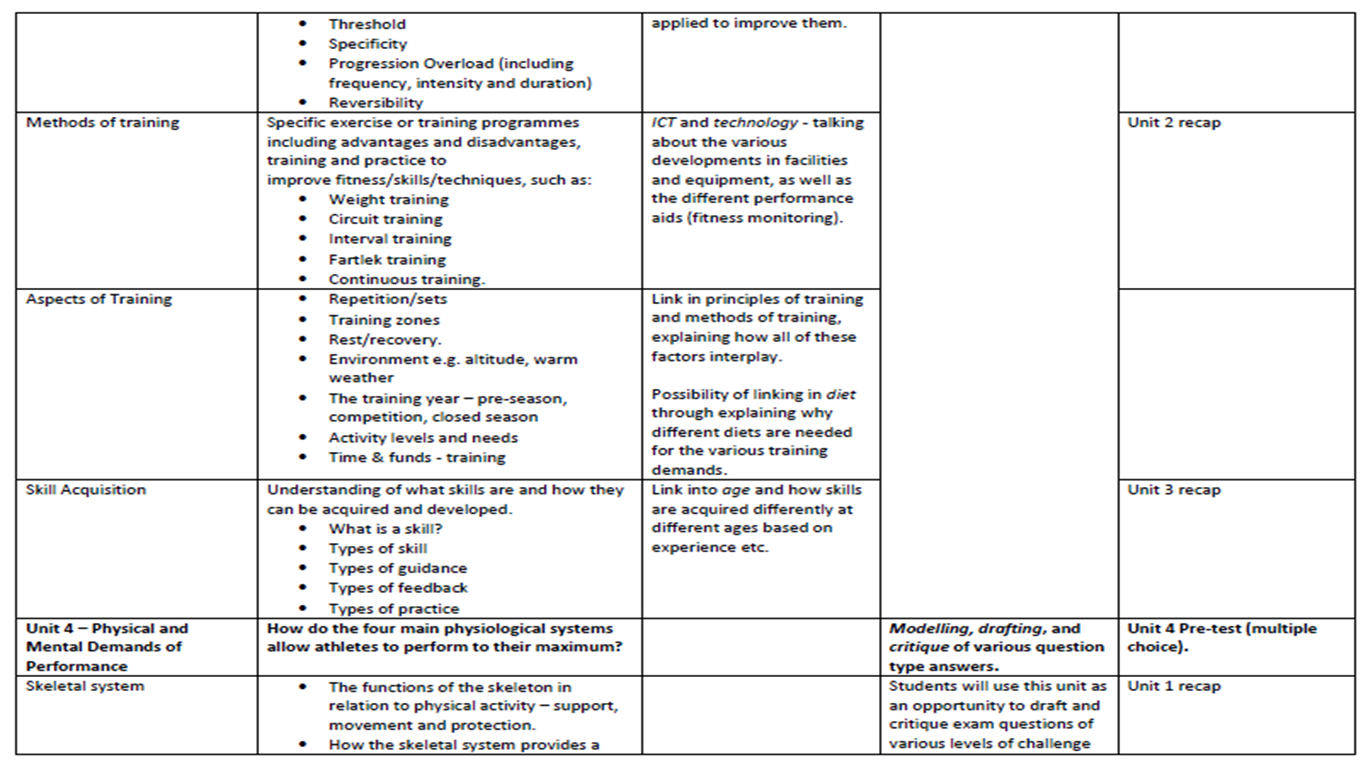
In reality though, when we looked at designing the curriculum this way we found it extremely difficult.   I mapped out (using a spread sheet) all of the topics that we taught, and then attempted to break up their order so they became constantly repeated.  I also tried to space them effectively so that forgetting came into play.  Working with this system became very confusing and meant that we would run out of curriculum time very quickly.  It is definitely something I will be working on next year within individual units.  Instead, we have tried hard to tie topics back into new learning so that students have to retrieve that knowledge and in return increase storage/retrieval strength.  For instance, in Unit 4 during the Circulatory system lesson, we have mapped it out that teachers tie in the Unit 2 topic of ICT in sport looking at measuring heart rate and training zones.  These opportunities are no longer left to chance and are mapped throughout the entire course.  We now have students retrieving various topics at relevant times throughout the course.


A look at Unit 2 and how it interleaves topics from Unit 1

I know it's not mathematically accurate and the spacing gaps aren't as precise as we would like, but it's hard in reality to transfer the best principles from research into practice.

3 – Spacing it out

You may have noticed in the point above that I have mentioned spacing.  I explain more about spacing here but it is basically revisiting information at spaced out times throughout a given period.  As Bjork explains:
"It is common sense that when we want to learn information, we study that information multiple times.  The schedules by which we space repetitions can make a huge difference, however, in how well we learn and retain information we study.  The spacing effect is the finding that information that is presented repeatedly over spaced intervals is learned much better than information that is repeated without intervals (i.e., massed presentation)"

Bjork also explains that the gaps between revisiting this information is also very important.  He suggests that each time we revisit it, the subsequent gap before the next time should increase, and then increase again and so on.  The aim it to allow students to almost forget the information.  When they come to retrieve it again the strength of it in your long term memory increases.


Ebbinghaus, 1885 - Note the increasing gaps between reviews and the decreased rate of forgetting.

As I have explained through the process of interleaving, it was really hard to space topics with the idea of increasing the spacing between retrieval.  How do I know when students are about to forget something so I can then refer to it?  With the spread sheet in hand I again tried to map out increasing gaps over the year.  Again I found that we would run out of curriculum time in only a few terms.  Instead we decided to group topics together in their units rather than individually.  We also used the natural roll out of the curriculum to increase spacing.  For instance, in Unit 1 we mapped out times you would recover Unit 1 topics.  When you get to Unit 2, you would have to revisit Unit 1 and Unit 2 information.  When you go all of the way to Unit 4, you would have to cover Unit 1, Unit 2 and Unit 3 information again.  Because there are more units to revisit, the gap between covering them again increases as well.


4 – Testing that is low stakes but high impact

Traditionally I have not been a great lover of testing.  It would be an option when needed but I didn’t see the full benefit that it has on learning.  Through the various readings we found that the use of tests actually is a key factor in helping information to be stored in the memory.  The process of having to retrieve information through a form of testing makes it more recallable in the future.  We also found that frequent testing has more beneficial effects than subsequent restudying of a topic.  In fact Roediger and Karpicke (2006) found that in one study, students remembered 61% of information from repeated retesting, compared to 40% from repeated study.

What we didn't want to do though is create lessons of monotony with lessons crammed with exam question after exam question.  Instead we created opportunities and methods of testing throughout the curriculum with various levels of pressure.  We therefore designed these four opportunities:


Note how in Unit 3 and 4 there are designated times for Unit recap tests.


Low stakes testing - In the testing column on the overview we spaced out (with increasing gaps) times when we ask our teachers to test old topics.  These tests are low stakes tests but force students to retrieve information.  We created a list of ideas including ‘Write down as many things as you can about topic x’ or ‘Challenge your partner, who can remember the most keywords from Unit Y’ to ‘Mindmap/Spider diagram all the links between topic A and B’.  The guidance we gave teachers is that these tests must be done in the allocated lessons and must last no longer than 5-10 minutes.  They can be done as bell work, a starter activity or even at the end of a lesson.  Providing answers should be quick and would be better if they could be done simply on one Power Point slide.  Students are now used to them as a sportsmen/women, enjoy the challenge and friendly competition.


Unit tests – Originally with our blocking of units, we would follow up learning with an end of unit test.  That test would purely focus on information from what has just been taught.  So in a Unit 4 test you would only see questions on topics from Unit 4.  This year we are including any question from any previously taught unit.  So in a Unit 3 test, you will now see questions from Unit 1, 2 and 3.  Teachers can formatively gather a sense of how well that unit has been learnt throughout lessons, but now also summatively see how they are doing within the full course.  Doing this allowed us to get students to retrieve old information and again increase its strength.

Multiple choice – Bjork’s work made reference to the benefits of multiple choice questions as a way of building up memory strength.  We now use an increased number of multiple choice questions throughout the curriculum.  In lessons we use hinge questions as one method on a regular basis.  We do this because if they are carefully crafted, the process that students take to work out correct and incorrect responses helps improve retention.  What we do with these though is follow up responses.  It could be easy for a student to simply indicate an answer with no thought.  We therefore create discussions or opportunities for students to verbalise their answer, even if it is incorrect.

Pre-tests – Based on Bjork’s work we now run pre-tests at the very start of each unit.  These take the form of multiple choice and last no longer than 10 minutes so curriculum time lost is very minimal.  The process provides cues and is thought to improve subsequent learning.  It also helps teachers gain a very quick insight into students prior understanding.


5 – Problem solving


In the first chapter in ‘Why Don’t Students Like School? Willingham explains that the brain spends a lot of this time helping us not to think.  Instead it prefers to do things automatically.  But, Willingham states that it does like to solve problems.  It is naturally curious.  It doesn't necessarily mean questions but we found this quite effective for us.  We therefore ensured that during each unit we mapped out larger driving questions.  For instance, in Unit 3, students were presented with the thought:
 “What factors do athletes need to focus on in order to reach and maintain a suitable fitness level for their sport?”

This was shared in the first lesson and everything that we subsequently learned built up a stronger ability to answer that question.  The question also allows us to tell a story about particular aspects of sport and make the various connections between topics.


To finish

What we haven’t done is created a robotic curriculum design.  We aren't constricted by what we have read or learnt.  The field of cognitive science is still not totally certain about all of its claims.  What we have simply done is taken the opportunity to use research to embed 5 simple principles that may help improve longer term retention of information.  Many of these changes are at the overview level so don’t put pressure on teachers to teach differently or in a set way.  It has simply allowed us to logistically map out key points throughout the year which we can focus on building memory strength.  There are no tips or tricks being used in lessons (unless staff wish to do so).  Instead we are using cognitive approaches to work hand in hand with learning to make it longer lasting.

In the next post I will look at how we designed our curriculum to improve levels of writing, the impact of feedback and the levels of stretch and challenge (with an A level twist!).