Friday, 28 December 2012

Literacy in PE


Literacy is a key theme this year and one which is being raised and commented a lot in various forums.  Ideas and discussion have flowed on Twitter.  Numerous blog ideas have looked at how to develop better reading or writing techniques with students.  I have had books recommended to me and courses have passed through my inbox.  Now I am no expert at all.  Not in the slightest.  In fact, at our last INSET day I had the pleasure to finally be a member of the audience and not actually be delivering any sessions.  This was a brilliant experience as I actually got a chance to learn new things of some amazing colleagues.  Now in terms of my own personal literacy I even attended a 'Spelling, punctuation and grammar' workshop where I spent most of the time grappling with apostrophes, colons, semicolons and so on.  For the first time in a number of years I was brought back to my childhood and had vivid recolections of my old school English lessons.  So many of the literacy skills I was taught seem to have been lost somewhere in the grey matter.


Obviously I can write.  I can structure reports and communicate effectively with parents.  I can produce instructions, explanations and descriptions for students which clearly make sense.  But as a PE teacher I had two niggling thoughts which kept me saying 'I could do more, I could do better!'.  In my PE lessons, particluarly in practical PE sessions, am I developing literacy skills with my students?  Am I creating opportunities, learning experiences or activities in my lessons that draw out key literacy skills?  The answer to be honest is probably no.  And if I was, I wasn't making it clear.  So could I do more?  Yes is the answer.  And could I do better?  Im afraid the answer is yes again.


At the end of the literacy INSET day we were given time to feedback about the various sessions we had attended.  We were also given time to collaborate with colleagues and come up with strategies and ideas for developing literacy further.  This time is where the magic happens and a number of ideas were developed.  Leaving this session the PE team were very excited about driving literacy within our practice.  But beyond our own department, I was constantly wondering what other schools and practicioners are doing.  Were there any ideas from other PE departments around the country (or globe) that we could use or even develop?  Whilst wondering about these questions I got together a number of Twitter PE teachers and set up the #literacyinpe hashtag, the Literacy in PE Dropbox and Google Doc.  Over the months a number of PE teachers have collaborated and combined ideas.  Inspiration has flowed and real trials have been shared.  In a subject where I personally had forgotten to highlight literacy regularly, a number of great strategies have been formed.  So what have we come up with?  Well, what follows is a summary of ideas for developing literacy in PE.  The list is in no particular order.  They have come from a number of contributors (see the bottom of the post).  Some of them may not neccaserily tick every box of every schools literacy agenda, but what they do achieve is a great starting point for other PE teachers to develop literacy in their departments.


Literacy in PE ideas:

Here is a collection of ideas that have been shared so far via e-mail/Twitter in an effort to develop literacy ideas in PE.  Please feel free to share further ideas, however small, which I can add to this list so that we can have a selection for teachers to use.  The criteria for an idea for this list is here:


  • Must have the improvement of literacy as its core aim
  • Needs to be manageable for all staff and all departments
  • Must be easy to use
  • Must have a clear impact on developing literacy, whether in the written or verbal form.


Fact in Fiction writing tasks - An excellent task for PE theory.  It is a task where students have to incorporate factual topics into fictional writing.  Really challenges their writing skills and demonstrates a clear understanding of the topics.  As a teacher you will have to write the opening few paragraphs of a fictional story and the students take over and finish it, incorporating the key points of whatever topic you are covering.  The need to include a list of points and key words which all must be underlined.  It also helps to develop extended writing and check for SPAG.  A good explanation of Fact in Fiction tasks can be found here.  I have also attached an example here: https://www.dropbox.com/s/taxt0pjugn6ghwc/Muscular%20Fact%20in%20Fiction%20Task.pdf

PEED/IDEA - We have also developed a 'PEED' (Point, Evidence, Explain, Develop) type strategy in our department called IDEA (Identify, Describe, Explain, Apply) which worked really well last year in the exam.  Really helped those who struggle to structure a scenario/long answer.  I have linked it here: https://www.dropbox.com/s/a761uxxi8qbmip7/How%20to%20Answer%20Longer%20Questions.pdf

SOLO Taxonomy - SOLO to help students structure long answer questions (picking out a fact, giving the definition, linking it to an example and bringing in other topics/aspects - going from pre-structural to EA).  Really links to the scenario and 8 mark questions in the AQA spec which students often find difficult to write. Paul McIntosh has an video example of this at A level PE http://mcintosh8.wordpress.com/2012/02/16/the-power-of-solo-taxonomy/

Student speak - We also teach our Year 7's & 8's how to give effective feedback through Sport Education so they can verbally structure it.  By teaching students how to give feedback to peers we are helping them how develop to use their verbal skills, choosing correct and specific terminology and thinking about how to give descriptions/instructions.  I have attached the resource here: https://www.dropbox.com/s/0vcxltin90zyruf/Rounders%20Good%20Feedback.pdf


School sports newspaper -  Happened a few years back.  Lasted 5 editions.  Had a team of sports reporters, writers and editors.  The team went to fixtures, wrote reports and then published them in our paper.  Printed copies were distributed to tutor groups and displayed outside the PE block and in the library.  Cost and time meant it had to stop.  Could this be a blog page now? An example of our front page from 2007 is above.

Key words/quotes - displayed around the department for students to develop terminology - increased exposure to these words can only help develop their use.


Articles - Using carefully selected articles in lessons which students can analyse and dissect.  During our cycling project we have used a number of online ones where students read them, analysed them and pulled out key information linked to the topic we were covering.  These rich resources explained what we were learning in such a clear and detailed way and contextualised the content that we were learning http://brookfieldcyclingproject.blogspot.co.uk/2012/12/developing-literacy-through-cycling.html   

Analysing articles - Here is a sheet I used with Yr 11 GCSE students when we read and analysed 4 cycling articles: https://www.dropbox.com/s/8fuyaqukc36nii6/Article%20Analysis.pdf
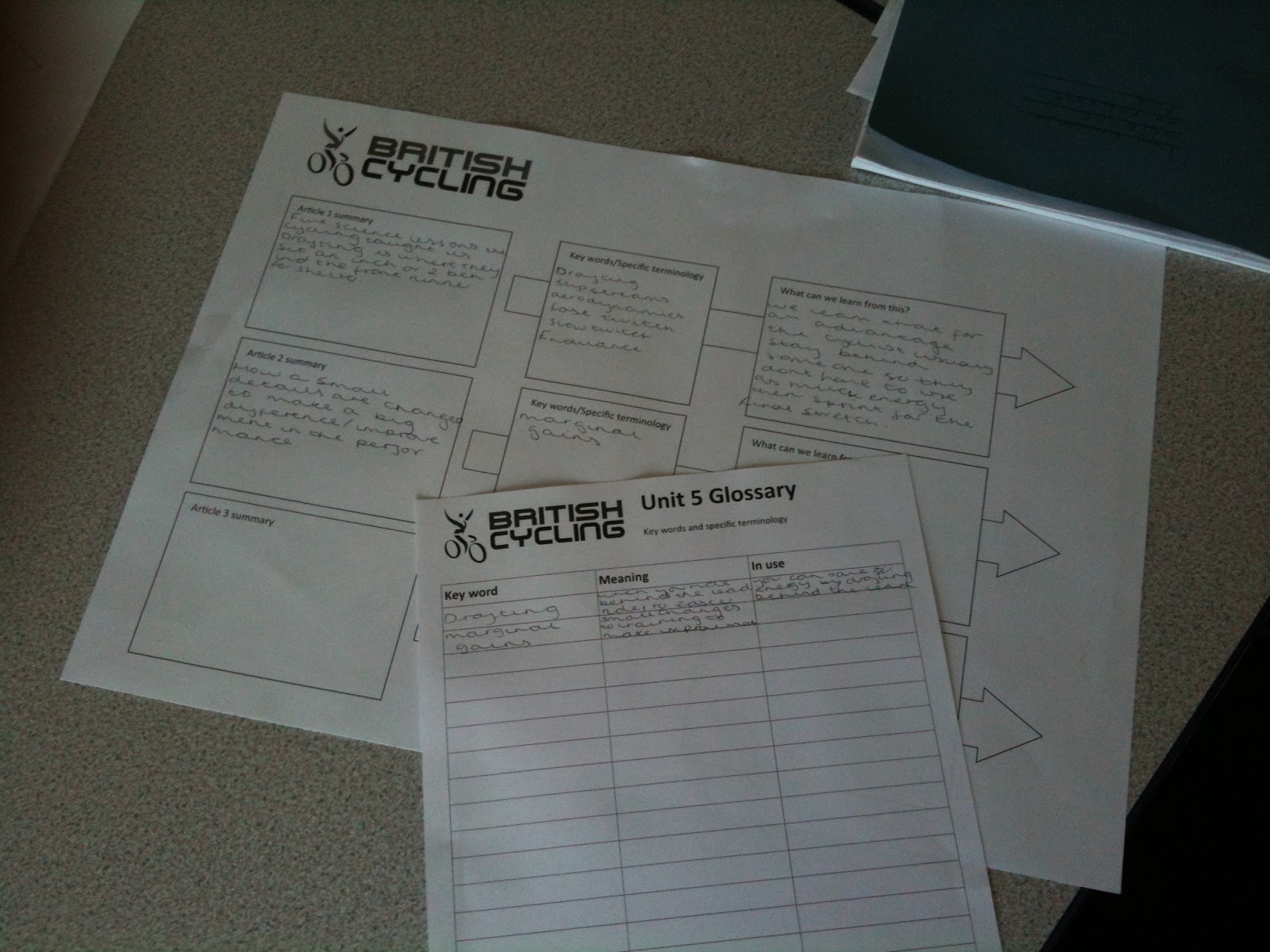


Unit glossary sheet - A simple sheet which students can transfer key terms, key words and specific terminology from any given topic: https://www.dropbox.com/s/jpw5huvwpa8zamz/Unit%205%20Glossary.pdf

Evernote - Using Evernote or similar voice note taking application to allow students to verbally explain written text, then share back with students to write up their explanation.  Completes a cycle of thought process and gets students to improve initial draft.


Blogs - Using Student blogs to access literacy.  Students write a blog post that reflects on their learning.  This is shared with their teacher who can give feedback both on the reflective part to aid progress but also on the literacy of the writing.  Here is an example of our student class blog that we are writing up for our cycling project http://brookfieldcyclingproject.blogspot.co.uk/

Reflection blogs - To encourage reflective writing all students will have access to either Edmodo or Posterous and will review their learning after each session.  This is aimed at getting students to write about what they have done and look at targets to improve.  The impact on literacy comes through the extra practice at writing and enhanced through modular focuses looking at writing structure.  A guide to this strategy from Matt Pullen can be found here: https://www.dropbox.com/s/f2orboa2phimw1w/Literacy%20in%20sport%20policy.doc?m

 
Questioning - ‘Pose, Pause, Pounce, Bounce’. You ‘Pose’ a question to the class; ‘Pause’ for an extended period of time (10-15secs); ‘Pounce’ on someone to answer the question; ‘Bounce’ to someone else to build or contest the original answer. May target lower ability for the immediate answer, and use higher ability students to extend.

Comic Life - Great for students to improve literacy in PE or any subject, the app costs £1.99 but is worth every penny. Students are fully engaged using the application and produce some fabulous pieces of work.  Jon Tait explains Comic Life further here.


Tagxedo - turns words - famous speeches, news articles, slogans and themes, even your love letters - into a visually stunning word cloud. Great for introducing new topics and keywords associated with it. Good to use with GCSE PE to act as prompts when students working independently on topics.

Word Replacement - When getting students to describe things adopt the “forget the first word that comes into your head policy”, basically the student must forget the first word they think of and replace it with another word this exercise extends students vocabulary.


Desk Writing - Encourage students to write on desks using whiteboard markers (an engaging alternative to their books) Students will love it trust me and not want to put the pen down.

Seek N Spell - Fantastic application for android and apple that not only gets students active, but encourages and develops literacy skills as students run to collect virtual letters and spell different words for points, students become really competitive.

Media - Develop a school media team and have students run it. The blog our students run and update can be found at www.westfieldpedept.wordpress.com.  Students are responsible for creating match reports and various articles and uploading them to the blog.

Audioboo application - This software allows students to create short & sharp podcasts to listen to as a quick revision of certain topics. Students  create their own podcasts and broadcast them through the departments twitter site in lessons, this once again allows us to instantly listen to the work created within the lesson and provide instant feedback on the work. The podcasting is a great way to improve students literacy skills without them really knowing. The students really enjoy making the podcasts and have come up with some sensational work. Once the files are uploaded to twitter, they are there for everyone to listen to and refer too for extra help during assignments and exams etc….

Skimming & Scanning - Students are shown a piece of information that relates to the upcoming lesson for 8 seconds, it is then removed. This exercise encourages and develops students ability to scan and skim pieces text.


Skype - We have used Skype in lessons to aid revision of subjects.  Colleagues and myself have set up Skype between classes and got students to ask the other classes questions through a live video feed to the other classroom.  This can be further developed to skyping to another school, this is something I did with success last year.  Enhances students communication skills.

Explain Everything - is an easy-to-use design tool that lets you annotate, animate, and narrate explanations and presentations. GCSE students can use this software to create tutorials and display their knowledge on specific subject areas.  By creating these, students have to carefully think of what to say, how to say it, what terminology to use and so on.

Explain Everything II - I use the above method to record student discussions in class for them to review later in their own time, it is expected that students make notes about the discussion after the lesson rather than during it to help with engagement in the discussion.

Literacy key words - Not very 'revolutionary' but this week when using an indoor facility, I have my objectives up, my success criteria, any techniques PLUS a designated section on the whiteboard with a minimum of 5 specific key words which they will learn/use in that practical lesson. Learners encouraged to use these whenever possible during peer/self assessment, reciprocal teaching etc.

Physical Literacy - A number of research articles into Physical Literacy, online (http://www.physical-literacy.org.uk/index.php) and also one shared in the Dropbox folder (https://www.dropbox.com/s/ozgqutbf7wphi20/physical%20literacy.pdf)

Comic Life - Using Comic life on iPad for non doers, take pictures of sessions and comment on students and what should be improved.  Can then share these or use as displays.

Reading corner - We developed a literacy reading corner, with a section in our sports centre on some comfortable chairs and on the table we had sports magazines, books about different sports stars.

Newsletter - We also have our Sports College newsletter which we produce every half term for the students to read and designed by the students. This did work well and was commented on by Ofsted. We are now as a whole school developing literacy even further. This is through having one literacy and numeracy co-ordinator in each faculty area. This then ensures the whole school is focusing on literacy.

Key Word Booklet - All key words for each department area will be collated in a whole school booklet which will be in each classroom and students can refer to.

Marking - When marking work teachers will circle under the spelling mistake (no highlighting or underlining) and students will put in the correct spelling. Dictionary in each classroom to help with this.

Focus Day - We had a suspended day with Year 7 in our area for the day and the students had to write and present a broadcast on one Olympic story from this year. They then linked to Art and Drama with the performance.


News Display Boards - Having an 'articles' board in our Sports Hall entrance.  The board is split into various topics from our GCSE course and each week we print off an article from a newspaper that relates to it, enlarge it, pull out key paragraphs/quotes and then have QR code links down the sides to similar articles online we have found.  Trying to encourage reading with all years and also supports our GCSE from Year 7.  I'm already tweeting articles out on my GCSE PE Twitter feed to my Year 11's.  Matt Pullen looked at this and developed this further by adding in augmented reality to bring words to life.  Simply record yourself talking through the article (or get students to do it).  This then makes it accessible to students that struggle to read English but understand spoken English.  Take photo of article in Aurasma, record voice on iPad or iPod using camera, link the two in Aurasma.  Voila.  Matt produced a post with a downloadable guide here which is an essential read.

Literacy mats - We're going to create some mats which have things like generic PE key words, connectives, verbs etc.  We'll use them predominantly in indoor lessons to help students verbalise their ideas and give feedback.  Bigger versions of them will be printed off and displayed on our walls to refer to.

Sports Quotes stories - An adapted idea from @AlysonEgerton.  Provide students with a number of sports quotes.  Students have to select one that inspires them and write a short story that ties in with the quote.  You can use this to focus on grammar, use of connectives, sentence structures....  Add a limit to the story to maybe 50 words, 75 words or 100 words.  Forces students to refine their writing and avoid waffle!

BTEC Verb progress mat - A colleague who leads the BTEC is going to create a mat that has key verbs, their meanings and how they relate to pass, merit and distinction (it seems most of the same verbs are used in the pass criteria, merit criteria and dist criteria).  The mat is designed to support at that level and show how to move onto the next level

Extended from idea above.  Student news blog.  Group of students write a blog post based on things going on around school.  Share this with students and get students to comment on posts.  Could be good for sharing positive things going on around school and also gives a student voice as they get to comment if they enjoyed things or how they could be improved.  This will start of focusing on 4 areas, digital literacy and use if devices in the classroom, sports news, from match reports, inter house and general PE news, house news, what is happening around school and finally post 16, integrating post 16 life into the rest of the school.  An excellent example from City Academy can be found here.

Ebook - Create an ebook that contains all the keywords needed for each subject.  These can then be simply shared with students to access when they need.  Using iPads this is quite easy to do using book creator app.  Within the ebook can be lots of links to other literacy ideas as well.  This is now being started using word salad to create keyword pictures contained in one book, engaging and useful`.  An explanation of this can be found here and an example of a BTEC ebook from Matt Pullen can be found here: http://db.tt/PqPAaI60

Marking Policy - A literacy marking key which teachers use on students work. Simply add a symbol or code where there is a literacy mistake and students refer to the key to see what needs improving.  Things on the key could be 'sp' for spelling, individual 'P', 'E', 'E', or 'D' for point, evidence ... which can be used in AQA scenario or long mark questions. Key can be on A4 and stuck in students books.

Literacy peer marking - When doing extended writing, swap work and get peers to mark for spelling, punctuation or grammar errors (content can be checked at same time or in second round of the peer review).

Voicethread - Use voicethread app to build students confidence in public speaking.  Take a picture and get them to write about it, then record just voice talking about it, then video self talking about it, then hopefully have confidence to present live.

Critique and drafting - Getting students to create multiple drafts of work which has set dates when it will be critiqued.  During this critique session, students use the rules 'Be kind, specific and helpful' and analyse the work.  They then provide feedback and feedforward for the writer.  The writer then acts on it.  By drafting and critiquing work numerous times, students are constantly developing their literacy skills.


Get in some experts - As part of the Cycling project we got in journalists who gave a literacy master class. These experts gave valuable pointers for writing articles, speeches, persuasive arguments etc. The top tips they gave are summarised here.

Whole school literacy focus - Each half term the whole school can have a literacy focus.  This could range from using capital letters correctly, using apostrophes, quotes, specific terminology and other SPAG points.  Students could then self assess or look for these foci within their work to further reinforce it.

Sport specific literacy booklet - For the particular sports that you teach you can have students fill out a literacy booklet which encourages them to use their relevant skills and learn specific terminology.  An example from Ben Horbury can be found here: https://www.dropbox.com/s/r2t8kvlvwzr0qmj/Football%20literacy%20booklet.docx?m


If you want some further details on these ideas, here is a video explaining seven of the above ideas in depth.  They were recently presented at a Youth Sports Trust event organised by @PEeducator


So there you have it.  These are just a simple list of ideas for developing literacy in PE but they could easily be transferred across any subject with small adaptations.  Obviously a more powerful strategy as pointed out by Peter Green would be to have a whole school drive or focus.  But, what we have here are a list of manageable and realistic literacy ideas that can easily be embedded at the start of the new term.

If you decide to use any of these please let us know using the #literacyinpe hashtag. 

So finally, who were the main contributors to this PE literacy project?  Here are a few (and must follows!):

Matthew Pullen @Mat6453 - All round good guy.  Big influence on me within PE teaching & learning.  Great advice on developing technology within PE.  Follow this guy at all costs.

Jon Tait @TeamTait - Not only a huge inspiration but a great Twitter friend.  Having collaborated with him both on Twitter and behind the scenes, this man knows his stuff and is motivated to develop T&L in PE further.

Ben Horbury @TheBenHorbury - The first PE teacher I followed of interacted with on Twitter.  Collaborated with Ben on a number of projects using SOLO, moderation, exam prep and now literacy in PE.  A must follow!

Glenn Martin @bod83 - An ex Bedord/De Montfort graduate (who I spent most of my time at Uni with).  Now a Director of Faculty but still very much a PE teacher at heart.  A great collaborater and knowledgable teacher.

Ben Leornard @PEeducator - PE teacher at Westfield Sports College.  A big driver of PE in the curriculum and using technology within lessons.  A great guy to follow and collaborate with.

Kevin Jones @kevjones27 - A PE teacher who is making a difference.  Keen on T&L and a great guy to chat to on Twitter.  Knows his stuff.

Peter Green @peter8green - Along with Ben, this is one of the first PE teachers I followed.  A great guy who I have collaborated with many times.  A great source of inspiration and well worth the follow.

Stephen O'Carroll @PE_SOC - Lead teacher of boys PE in a London Academy.  A PE teacher through and through.  Full of ideas on driving the subject forward.

Paul McEvoy @MrMacPE - Teaching & Learning Coach, PE teacher,TES top resource contributor and football coach.  A great source of ideas and inspiration on Twitter.

Ross Wickens @MrWickensPE - Trainee PE teacher at Loughborough University.  Key resource on Twitter and sharer of many great links and articles.  Has a great blog covering many aspects of education, particularly technology in the classroom.

Saturday, 8 December 2012

The Big Read - Developing reading, literacy and responsibility

This year we are launching our biggest Learning to Learn programme of all time called 'Learning at Brookfield' or L@B for short.  It is a whole school initiative that focuses purely on Year 7's.  We are using Dweck's Growth Mindset and the 5R's as the basis of our programme.  Each half term we focus on one of the R's.  In that half term period, two departments champion this attribute explicitly, whilst the remaining teaching staff promote it informally.


This first half term we have been focusing on 'I am a Responsible Learner'.  The English department are one of the two championing departments and have been running an exciting project to promote responsibility, literacy and reading.  It is called the 'Brookfield Big Read'.  Sarah Page, an English teacher at Brookfield summarises the project as follows:


The ‘Brookfield Big Read’ is a challenge that runs for six weeks at the start of Year Seven. There are several aims. Primarily, it is to foster a love of reading for pleasure. For some readers, this means encouraging them to continue with the good reading habits that many of them have developed at our feeder primary schools. For these readers, the objective is to expose them to a wider variety of texts and authors and to inspire them to read more challenging books. For other readers, the ‘Brookfield Big Read’ aims to support them in developing good reading habits by challenging them to read more regularly and to discuss their reading with parents and peers. In addition to developing a culture of reading with the pupils, another of the challenge’s goals is to promote responsibility and independence in the students’ attitude to learning.  Overall, the aim is to motivate Year seven pupils to develop an enthusiasm for reading whilst taking responsibility for setting themselves targets and achieving their goals.


At the start of the challenge, all pupils are issued with their ‘Brookfield Big Read’ card. On this card they set themselves as many as three overall challenges, which they aim to achieve over the six weeks. Then they have to set themselves weekly targets in order to achieve their goals. Examples of targets might be to read a trilogy of books by a particular author or to read as regularly as half an hour each day.
Each week pupils are expected to discuss their reading with their parents and ask their parents to sign off their target. The class teacher will discuss each pupil’s challenge with them throughout the six weeks and also set aside time for pupils to read during class. The pupils love to share what they have read and this often supports and inspires others in the class, so often the class teacher will ask pupils to read out from their novels or to recommend their novels to the rest of the class.
Pupils can gain L@B merit points if they demonstrate responsibility during their challenge. Therefore not only do they need to complete their targets and ask parents to sign their cards, but they also need to ensure that they renew their library books on time and bring a reading book when asked to by the class teacher.


At the end of the challenge there is a class celebration of all of their achievements. Pupils are asked to present what they have enjoyed about the challenge and to share the texts they have relished. It is an opportunity for pupils to reflect on what they have read and how they have become responsible for their learning.

After introducing the challenge and linking it explicitly to our L@B focus, students began to set themselves their own targets.  As Sarah explained, these targets varied from students to students dependant on their initial level of reading.  Teachers helped students where necessary but ultimately these targets were self set by students which allowed them to take ownership of them.  It also provides that extra piece of motivation to achieve them when it is one that they set themselves.  When responsibility and self regulation are what we are trying to promote, giving them full control is key.  So what were some of these targets?  Well here are a few examples from our students:  

  • To ready 20 pages every evening.  (The Hobbit - JRR Tolkein)
  • To read aloud to my mum 3 times a week.  (Flash Flood - Chris Ryan)
  • To read an entire book from a different genre.  (I Shall Wear Midnight - Terry Pratchett)
  • To read 4 chapters a day
  • Read three books
  • To read for an hour a day
  • 20 pages a night
  • To read a book recommended by my Mum
  • To read a different author/genre
  • Read a book recommended on Frog
  • To read a book a week
  • 50 mins a day
  • Longer and more challenging texts
  • To read half a book a week

At the beginning of every lesson, students would spend 10 minutes reading silently whilst the teacher went round and discussed targets with the students.  Over the weeks students filled out their Big Read Challenge card with new targets and comments, concluding the challenge with a final evaluative comment.  Parents signed these cards at home when their child had met their daily/weekly target.  This helped both support the child and provide motivation where needed.  When it got to the end of the six week challenge, students assessed whether they had met the target.  In fact many of the students had not only met their personal challenge, but even exceeded it.  Students were then asked to write a review of the six weeks, discussing the book or books they had read and also reflect on how responsible they had been.  A few examples of the book reviews can be found here and here.  This was an excellent chance review their progress and highlight any L@B examples.  To add a further element to this challenge, a selection of students work would be publicly exhibited at our local Waterstones store.  The reason for this ties into Ron Berger's 'An Ethic of Excellence' book (which I highly recommend that you read) and gave students a real audience, which in turn instilled a sense of pride when completing their work.  Many students asked when the display would be up which only increased the profile of the challenge further.    


And the last element for the students would be explained in our Year 7 L@B assembly.   As they were working through the challenge, the English teachers had been monitoring how Responsible these students had been.  They had been particularly looking at the way the students were learning, not just what they learnt.  They had forwarded these names to me as 'nominations' with examples of how they had become a more responsible learner.  Here is an example of 10 students:

  1. A.M: A student who has really focused on a being a responsible learner. He works well in groups, on his own and has, without fail, met the 'Big Read' requirements (remembered his book every lesson, 'Big Read' card signed every week and he has increased his reading from nothing at all to 15 minutes a day).
  2. A.H: Arranging to hand in early as she knew she would be absent; excellent attitude throughout.
  3. T.H: Using initiative to support others (one of the Responsible Learner criteria)
  4. A.K: Seeking ways to extend her work always (taking on responsibility for her own learning)
  5. E.N: Responding enthusiastically to a challenge and striving to meet it.
  6. H.N: He has worked very hard on his reading and has independently written two reviews about books he has read.
  7. C.M: For her continued enthusiasm with the Big Read project, completion of an excellent book review and for setting great targets every week.

  8. L.T: She has read 7 books in total, challenging herself all the way. She has produced some excellent work as a result and handed in a superb review.

  9. J.M: he has taken the challenge very seriously, set herself thoughtful targets and taken great responsibility over the management of her time.  She has clearly enjoyed it, as has mum who has left some very detailed comments!
  10. Z.P: Amazing effort towards work in class, her book is exemplary and she responded to extending her BIG READ challenge and produced several book review.
These students were highlighted in assembly as individuals demonstrating excellent learning qualities.  In particular, we used them as examples of being responsible learners and as role models for other students.  They represented a shift towards being 'Growth Learners' and made becoming a better learner achievable for other students.  They were rewarded with certificates and one of our Responsible learner wristbands.


So what are the English departments overall thoughts after this exciting challenge? Neil Chance, our English AST, summarises it here:

During the course of the Big Read Challenge, students were openly discussing learner attributes, and, more specifically, the skills required to become responsible learners. Students really enjoyed the challenge of setting their own targets and managing them, and were fairly consistent at bringing in their own private reading material. The focus on 'responsibility' allowed teachers to highlight successes and difficulties in lessons, as well as providing opportunities for discussing methods to tackle those difficulties.


Targets were sometimes met and exceeded; other times they were not achieved - often because the target itself was too challenging (but this was encouraged at the beginning of Year 7 as teachers were still becoming acquainted with the strengths and weaknesses of their students). Whether the 'responsible' focus helped students achieve their targets is difficult to ascertain without a more in depth investigation - but it certainly didn't hinder them!


As a department, next year the focus would be on promoting the L@B skills more explicitly and asking students to become more self-aware and reflective regarding their own strengths and weaknesses as 'responsible' students.

As our first flagship challenge for our L@B programme, the Big Read has had a huge impact within our school.  The challenge itself, the learning conversations, the public exhibition and the reinforcing of such as vital quality (being responsible) and the push towards becoming a Growth Learner has been amazing.  We may not have turned every single student into a responsible learner or avid reader, but we have taken steps to highlight these areas with our students.  We have also begun to embed the culture of learning and exceptional learners at our school and look forward to the remainder of the year and the rest of the L@B programme.

Sunday, 25 November 2012

Looking beyond a lesson in SOLO


Now I have been using SOLO in my GCSE PE classes since April 2012.  I have to say that for me, as a non classroom specialist, it was an excellent way to ensure I had structure in my lesson.  It was much simpler than my previous 'Blooms and Accelerated Learning Cycle' mash up I was using and actually did the same things more effectively and efficiently.  It helped me plan a journey that consistently took my students from shallow to deep learning.  Now I am more versed in it and have 'seemed' to got a very good grip on it, I started to wonder if I needed to be so rigid in my use of it.  Do I simply have to use SOLO taxonomy as a way to structure a lesson and develop levels of learning?  Did it have to be the format for just my lesson planning or could I go beyond this and use it in a more powerful way?  So over the last term I have been looking at how I could develop my use of SOLO taxonomy and use its ideals as a means for things that have a bit more impact.


Non linear
When I first started using SOLO, to get a grip of it I methodically planned learning and any activities to go from Pre/Uni-structural to Extended Abstract.  I simply used it as a ladder to get from A to B and ensure that all of my class experienced shallow to deep learning.  For a PE teacher this really worked as the many individual pieces of information where learnt, assembled with other pieces, linked together and then stretched at the end.  Learning flowed and progression was very obvious and apparent.  It made so much sense.  After reading a post from Martin Said (@saidthemac) though which is found here, I did start thinking that getting to the deep learning element didn't have to be so regimented.  You don't always have to start at Pre/Uni-structural and move to Extended Abstract.  Instead, why not start with the challenge of an EA level of thinking and then work back through the taxonomy to answer it.  Why not have a driving question to begin with?  I liked this idea so tried a few lessons where I shared a big objective or outcome which was designed at the EA level of a particular topic.  I sold this as the 'bigger picture' or as a challenge for the class.  In order for learners to be able to achieve this objective/outcome, they had to go back through the taxonomy and gather information, relate it, analyse and evaluate.....all in the aim of completing the larger goal (the EA task).  It really worked and allowed students to contextualise the learning and see the goal they were working towards.


Questioning
Well thought out, effective and directed questioning is a integral tool for us as teachers.  Amongst its uses, it is a great way to check understanding, a way to check progress and a way to challenge students to think about a topic in more detail/in an alternative way.  Part of the work on SOLO involved creating a clear SOLO verb list which I use in many ways such as creating learning objectives, and now to structure my questioning.  The verbs  provide a great scaffold in planning out your questions before lessons.  It also allows you to think about the complexity of what you will be asking and who you will be targeting questions towards (asking those that need extending in your lessons the more challenging questions).


Using Pam Hook's verb list to plan out questions (very basic examples).

By using the verb list during your lesson planning, you can tie in relevant questions to the various SOLO stages.  The list also acts as a prompt in creating questions to check students have learnt the all important content knowledge (using verbs such as define, describe, combine, explain, apply, analyse......).  It can then be used to extend the thinking of a topic further and challenge students (by asking them to predict, hypothesise, evaluate.....all of which can only be done if the content knowledge is there).  These can also be used when designing tasks or written work.


Learning objectives
As a result of playing around with SOLO, my learning objectives/outcomes/thingymajigs changed.  I got some inspiration with a @learningspy post that looked at a Jackie Beere idea of 'Learning continuums' (found here).  The idea is instead of having a list of bullet pointed objectives, you could have objectives placed along a continuum that show the learning journey that will take place in that lesson.  To me, this seemed to link perfectly with the process of SOLO which is to move from shallow to deep learning and up the taxonomy.  Objectives that ranged from Multistructural to Extended Abstract could be placed on this continuum and shared with students.  This allows students to see the full picture of the lesson and see the criteria that must be met in order to achieve mastery in that particular topic.  It also makes progress very obvious and apparent.  The use of Pam Hook's SOLO verbs could also help structure the terminology used in the objectives in order to develop levels of thinking/learning.


Feedback - feedforward (Using the stages of SOLO with students for feedback and feedforward)
Such a simple change in terminology has such powerful impact.  At our school, in Key Stage 3 we use 'two stars and a wish' as the process of giving feedback on things like homework, classwork etc.  I myself am not a big fan of the 'wish' element as I wish I had £1million pounds but it's probably never going to happen.  The wish for me just seems out of reach and could be worded better (like Geoff Petty's Medal & Mission feedback is for example).  Whether or not the use of words is suitable or not, the idea is to get our students to get reflective comments on their work as well as a piece of advice on how to move forward.  When we get to Key Stage 4, the terminology of the two stars system seems a little out of date.  This is where SOLO comes into its element.  I follow @dkmead (and highly recommend you do as well!) who to me is the guru of all things learning.  It was through a few tweets of his that I came across the term feedforward, as well as the obvious term feedback.  This new term linked to Pam Hooks three key questions "What am I learning?  How am I doing?" and most importantly "What do I need to do to develop a deeper understanding".  Feedback is concerned with reflecting on the learning and providing comments about how well this process has taken place.  Feedforward on the other hand is the provision of comments to move the learning forward.  It's the comments or conversation we have that helps learners move to the next level or stage in the learning process.  Because SOLO has clear and distinguished levels of learning, it is so easy for a teacher to give feedback and then explain how to move to the next level of the taxonomy using this feedforward ("You're currently at multi-structural because you.........and what you need to move forward and get to relational level is.....").  Once this terminology is the norm in your classroom, it is then very easy for students to do this at any point when working through SOLO.  Chris Harte gives a more detailed and much better explanation of feedforward here.  So this has now become common in my lessons.  It has also helped me provide more structured comments on learners work and helped them see where they are at and how to develop their knowledge of a topic. 

Students work with Feedback in blue and Feedforward in green.


Using SOLO to differentiate
SOLO is a great tool for differentiating learning with your students.  The nature of the taxonomy allows students to have what they do focused specifically on their needs (existing knowledge, targets, ability).  There should be no reason to pull the whole class along with the same task at the same pace.  When using SOLO in your lessons, it is possible to differentiate in the following ways:


Different starting points:  By having students self assess themselves at the start of the lesson against a rubrics, students may naturally know more about this particular topic then you had realised.  By students having different starting points, you can differentiate tasks out easily so students aren't completing activities that don't actually stretch them or build upon their knowledge.  You may decide to have students choose tasks from a set list based on their starting point, or have them select a task from SOLO trays at the front of the class, or even group students based on their starting point (all the students starting a multi-structural come to these tables....).  


Tasks themselves become progressively harder (very basic differentiation):  Very obvious but designing the learning that takes place at each SOLO level naturally makes the work become progressively harder.  Some students may move onto the more difficult tasks quicker than others and SOLO has helped you plan ways to stretch these individuals.

Different students/tables/groups can have different tasks:  As stated earlier, linked to some uses at local primary schools I have visited, students work on different tables for different SOLO tasks or different SOLO starting points.

Some higher level tasks are ‘open’ and allow differentiated outcomes:  Some of the more extend or abstract tasks (EA levels) naturally allow for an open ended outcome. By allowing this element of interpretation and the chance for students to create something unique, the level of the outcome may vary.


SOLO projects (one topic is actually a multi-structural part of another topic)
We teach units in our GCSE PE course.  In these units we have carefully grouped similar topics together which have a common theme or overlap. Since April, for each of these topics I have taught them using SOLO and taken a journey from Pre-structural/Uni-structural to Extended Abstract.  At times these topics seem very separate rather than parts of a whole.  What I don't think is always apparent to learners is how these topics link to a bigger picture.  And that's where I have decided to teach things a little differently.


So during the summer of 2012, whilst watching the Olympics, I started to think if there was a way that I could teach a theory unit with SOLO as its structure.  Now I have completed a project based on this thinking and have blogged about it here.  What I did was think of an Extended Abstract outcome for the unit based on 'How can we persuade the media to give more weight to cycling in the press?' (Thanks @saidthemac for the help!).  I then looked at topics that I had left to teach that year and linked these within the project.  Each of the topics that could help answer the question (role models, media in sport, technology in sport, sponsorship......) were covered and taught.  Students learnt about each individually and went through the SOLO process to become Relational or Extended Abstract in each.  But each of these topics are actually a Multi-structural strand of the bigger unit.  Using the project as the driving force, the students were able to link these topics together (which they do, but sometimes students don't see that).  Now each of these topics became relational within the unit.  All that was left was to use this knowledge to answer the unit driving question and learners have moved onto Extended Abstract.


Planning schemes
Finally, we have been discussing schemes of work in our department for KS3 and are looking to rewrite them.  We don't currently use SOLO with these year groups.  But I was thinking that even if not shared explicitly with students, could we use SOLO as a planning tool for schemes.  If we mapped out the individual elements that we needed to teach (Multi-structural components) and then designed a scheme that would develop these with learners, connect them together (Relational) and then have a big outcome (Extended Abstract) as the form of an assessment, then maybe this can ensure all of our schemes are methodically designed to get from shallow to deep learning.  This is only an idea and has had very little thought, but is one I aim to sit down and visit in the near future.

Tuesday, 16 October 2012

Developing reading with..........teachers!

This post has been created as a result of a post back in April 2012 where I compiled a list of books with the help of Twitter which would benefit teachers in our school (click here).  The reason I did this came from our amazing librarian Helen Smith.  Anyone who has worked in schools for a long time will tell you there are certain people you need to get to know as they are a valuable resource in your school (caretaker, receptionists, admin staff.....).  Helen, our library resource centre manager is one of them.  We are very lucky at Brookfield to have one of the best libraries that I have seen in a school.  We have over 18,500 resources in our Library Resource Centre for staff and students to borrow.  The LRC is used by approximately 10,000 staff and students each month.  Students are encouraged to be independent users of the LRC and to return and borrow books as they wish, similar to a public library.  Classes are also booked in to conduct research using the integrated ICT facilities (PC's & iPads).  Helen changes the displays on a regular basis in line with a current topic in the news or being studied in school or on a fiction theme. 


Excellent resources to conduct research or simply read!

At the moment she is promoting a selection of books the School Library Services has recommended.  We have also been lucky enough budget wise to be able to purchase stock that the students are interested in, especially boys.  We purchase lots of books which students can ‘dip’ into, especially with our short breaks.  Dr.Who, Star Wars, Guinness Book of Records, Ripley’s, Top Ten, Where’s Wally etc.  Students also know that if the next book in a series, or a new book, is due out, they can ask us and we will purchase it.  They can read it first and then it goes on the shelves for general borrowing, but usually they have told their friends about it and there is a queue!  This gives students and staff a sense of ownership.  We also buy several copies of popular books i.e. Diary of a Wimpy Kid, Twilight, Skulduggery Pleasant etc.

One part of our Staff Library

But there is one area in the library which is purely dedicated to staff and professional development.  The staff library section is well displayed and and a well resourced part of the LRC.  It currently boasts 252 books which cover a variety of educational topics such as behaviour management, subject specific resources, books for governors, texts on leadership, starters, plenaries, evidence based research.....  In fact the list is endless.  We all know, as a profession, keeping up to date on new ideas, pedagogy, research and initiatives is vital.  There are an abundance of inspirational and exciting books out there which in many teachers experiences have transformed their practise for the better.  Helen has done a fantastic job in resourcing the library and is now looking to entice staff into using this section more frequently.


Now as a member of the Learning & Teaching group involved in driving new practise in our school, I have been working with Helen to update our staff library books and refresh them with some of the books being highly recommended at the moment.  Many of these new books have come off of the 'Must reads for teachers' blog post that so many teachers helped contribute to.  My aim is to encourage more staff to undertake professional reading.  We are a good school very close to being outstanding.  We have a vast amount of inspiring teachers and having these excellent resources at our disposal can only help enhance the work we are doing.  Many of them have exceptional ideas and share a wealth of knowledge.  As part of Helen's aim, the use of the library is important and developing a culture of staff using the specific 'staff library' section is also key.  Although year on year teachers consistently use the staff library (see graph above), it isn't as high as it should be in comparison to our overall number of teachers/support staff we have.  As a result, Helen has come up with the following strategies which she is launching with staff after our INSET day this term.  She aims to roll out each of the ideas and hopefully introduce this magnificent resource to many of the teachers who didn't know it existed or who have rarely used it.  In summary, she will:
  • 'Weed out' the staff library and begin removing out of date books and replacing them with current resources/pedagogy.  Latest titles have included 'An Ethic of Excellence' and 'Full on Learning' to name a few.
  • Email staff for request/suggestions for new books
  • Establish a culture of staff being able to ask for a book and being the first to borrow them
  • Make Flyer's advertising the books, especially new ones. These can be sent by email, given out during Inset, displayed in staff room, notice boards within school
Our 'Recommended Staff reading' flyer which will be given out in our Oct INSET

  • Create an information leaflet to be given to new staff on how to use the LRC and what is available to them
  • Demonstrate SearchStar (library programme) to individuals or during an Inset to show how they can look to see if a book is available
  • Encourage personal fiction reading as this brings staff into the LRC by purchasing ‘mature’ reads
  • Encourage table use in the LRC by staff as this familiarises them with the space and the books
  • Have an Open Day for staff with coffee and tea. They can view stock and the staff library.
Hopefully these simple and manageable strategies will encourage staff to begin a journey along continued professional reading.  Hopefully it will encourage a ethos with staff to keep up to date on current ideas, pedagogy and practise.  Hopefully, it will help create a professional dialouge with teachers and begin the many wonderful learning conversations that I am lucky enough to have with teachers on Twitter, but this time within our school.  Hopefully it will inspire many new and existing staff to get involed with teaching and learning in our school (as blogged about here).  And probably, and most importantly, it will help staff refine their current practise so that it ultimately has a positive and beneficial impact on the learners, and learning, that takes place in their classroom.  I would urge you, if you don't have a facility like this set up, work with your librarian and see if you can develop one.  Use my list of must read books to get you started if you need to.  It is worth the time and could be such an amazing tool for a school to have up their sleeve, and one that if promoted with staff like we are, could benefit us all.

Sunday, 7 October 2012

Developing Olympic Learners

 A few months ago I talked about the exciting journey our school would be undertaking this year.  From September, we have implemented a whole school Learning to Learn programme that is specifically focused for our new Year 7's.  As we are mid way through this half term, I thought you might be interested in seeing what we have done to develop our 'Olympic Learners' (all will become clear).

If you are a first time reader and are not sure what I am talking about, we have run Learning to Learn for a number of years now as both an integrated part of PHSE and as a discrete course for our Year 9's in preparation for GCSE.  Both were not ideal and both had variations on success.  Our dream though was, and always has been, to implement this with our Year 7 learners as they entered Brookfield for the first time.  We wanted to work with them as soon as possible because this is a time when they are most malleable and receptive to our efforts in creating effective learners.

So what is the thinking behind our L2L programme?  Well, its pretty simple really.  The whole course is built upon Dweck's mindset theories.  At Brookfield, we want learners who recognise things like effort has a big influence on learning, who understand mistakes are good to learn from, who know that easy tasks are pointless if you don't learn anything and like a muscle, your brain can grow stronger through learning.  To do this we have adopted the 5R's and renamed them as:
  • I am a responsible learner
  • I am a determined learner
  • I am a resourceful learner
  • I am an effective thinker
  • I am a reflective learner
We believe that if students can adapt their mindset and develop their 5R's, they can become more effective learners.  We've worked hard to extract the snake oil and design a programme full of ideas, strategies and protocols that we know learners need and have worked for us over the last 7 years.  So, here's what we've done this half term:


Launched it with staff

Our official launch with staff was in the summer term of last year.  A copy of the presentation for middle leaders and SLT is here.  The staff launch can be found here.  At the start of this year I simply used morning briefing and e-mail to remind staff of the programme.  It is essential that all staff are involved in the process and collectively promote this programme.  The students need the key principles to be reinforced by all teachers in order for the programme to have its full potential.  Response from departments so far seems great and I have had a number of excellent learning conversations as a results with colleagues about how it is really helping.


Developed displays around school (and our staff room)

Thanks to Marvel, we have assigned each of our learner attributes to a comic book character.  This has been an excellent hook for the students (and some of the staff too).  At the end of last year I asked departments to put in an order for our large posters.  Core subjects and large learning spaces could choose two posters which our budget paid for.  We did this because students go to these subjects, or use these spaces the most.  More exposure to the attributes will in return help us embed the programme.  Every other department received one free poster.  Electronic originals are available on our network and can be printed from department budgets for individual classrooms. 


L@B Display in the English corridor

Some other areas, including our library, have created their own unique displays (which are fantastic) and once again helped promote the five qualities.  In fact, in a general walk around part of the school last week, I found four personalised displays with a L@B focus which is such a positive sign!

L@B display in our school library


Talked about responsibility, responsibility, responsibility (our half term focus)

Every half term we focus on a different attribute.  This first half term has been focused on 'I am a responsible learner'.  Two departments at a time have championed this attribute with specially designed activities, but the rest of the school have been mentioning responsibility whenever they can.  We ran with this first because it is a simple focus to begin with and links in really well to a lot of the work done previously in our feeder schools.  In PE, we've used the word 'responsibility' a lot and tried to help raise its awareness as much as possible.  Students are really responding and are actually showing that they are responsible (no really they are!).  It has also been an excellent way to structure a learning conversation with a student who isn't demonstrating this quality.  Simply referring to the many posters around school with the student quickly help them see where they need to improve.  I've had a lot of good reports back from colleagues across the school where this focus has been embedded.


Organisers

Our Year 7 organisers (student planners) arrived and have designated L@B pages in them.  The aim of this is again to raise the profile of our L2L programme with students.  If needed, teachers, students and parents can refer to this page if needed when structuring learning conversations.  Hopefully these can be used in classrooms and at home with learners in an effort to reinforce them.

The page which is found in our student organisers
L@B Champions:  English and Maths

These two departments are our first champions.  English have chosen to run a project called 'The Big Read'.  The challenge involves students setting their own reading target for the half term and being responsible in their self-regulation to achieve this.  Our students will visit this project throughout the half term and reflect on progress.  Students will keep a record of their progress within this challenge and reflect on how responsible they were in meeting their target.  As part of this project, both Waterstones stores in Southampton will publicly display the students reviews.

A slide from 'The Big Read' launch in English

In Maths, students have been working through a data analysis task which really promotes team work which is one of our responsibility strands.  They have really embraced split screen teaching as a way to deliver this and made the process of learning really explicit.  Comments from staff (including a Deputy Head who is teaching this scheme) are very positive and show promising signs for helping shape our students learning behaviour (especially 'working with others' which for some students normally means having a chat!).

A slide from the 'team work' lessons in Maths


L@B merits (over 700 so far)

Our SIMS system now has L@B merits, including Responsible learner, added to the list.  This means that staff can quickly and easily give our specific attribute merits.  So far, 4 weeks in, over 700 responsible merit points have been given out.  This is excellent and really helps reinforce our focus with learners.


Wristbands

Designed as both a reward and as a way to raise profile of L2L, we will be handing wristbands to the top 20 Responsible learners in Year 7.  These individuals are selected by a mixture of L@B responsible merit points and recommendations from teachers in both English and Maths.  Each focus has a different colour.  This half term it's green bands! 


L@B champions

Our students voice of L2L.  These are a group of 12 Year 10 students who went through the last L2L discrete subject programme.  Each student is linked to one of the 5 attributes and acts as an ambassador.  So far these students have helped me plan and run the Year 7 launch assembly.  They are a credit to the school!  Their next project is to survey and interview randomly selected Year 7 students and ascertain how well the L@B programme is being embedded.


Launching with students (assembly)

Now if you watched the Olympics over the summer, you were probably as inspired by the immense achievements of our athletes as I was.  In fact, for the first time, I got a real attachment to the Olympics which I have never had before.  I am in awe of the athletes and feel that we can learn a lot from their character, their focus, their training, motivation, commitment......  I also thought that our Year 7's could learn from them as well.  So, with the help of my Year 10 champions, we designed an assembly to launch L@B whilst harnessing the power of the Olympics.


The assembly message was simple.  Imagine yourselves as 'Olympian learners'.  Olympians train hard for four years with the goal of gaining a medal at the event.  They put in hours of training, hard work, effort, commitment and dedication.  They have regular competitions in between to measure their progress and make amendments if needed.  They learn from setbacks and strengthen weaknesses.  They have amazing support and dedicated coaches who aim to make them better and experts in their field.  Now, remove the sports analogies and replace them with school and learning, and you all are Olympians.  In four years you will be in Year 11, preparing for you Olympic competition (exams), with the aim of gaining a medal (A*-C), with the support of your expert coaches (teachers) and have constantly been monitoring your progress and strengths (assessments, feedback....).  This 'Olympian Learner' concept is something I will use a lot and hopefully will help students see the qualities they need and the journey they must take.


Languages day link

Every half term we have a focus day.  This half term was our schools European Day of Languages on 26th September which we ran with Year 7's.  Every focus day has one of our five attributes attached to it, so this half term we had 'I am a Responsible Learner'.  The day began with an assembly in which I bridged the link between languages and being a responsible learner.  I have to say a huge thank you to Ian Gilbert who helped me put together the speech with some inspirational ideas to share.  The day was successful and challenged the students a lot.  The principle of being responsible to reinforced throughout and is something we will continue to build upon.


Reward cards

I have talked about these in a previous post (click here) but they are simple colour co-ordinated feedback cards.  Each card is linked in colour to one of the 5 attributes.  Each card also has a short learner comment, statement, habit or skill which links to that attribute.  If a teacher sees a learner demonstrating that particular habit in a lesson, they simply give that student the card which in turn is rewarded with a merit.  The card quickly identifies the particular habit that the student has used so the individual knows what the reward is for.  By encouraging and reinforcing learners to work in a particular way, it should help them develop positive habits which will make them successful learners (links to Skinners and Thorndike's Reinforcement and Operant conditioning).  If you would like a copy of the cards, they can be found here and here.  These were e-mailed out to staff to use if they wish and already a number have been passed through our reporgraphics department.  I look forward to hearing how well they get used.


Now that's quite a lot of things going on in the first half term but the combination of them all should ensure that our L2L programme has a huge impact.  It's the small but manageable details that come together to help create a programme purely designed to benefit our learners.  For the rest of the year, we will move onto a new attribute each half term and work through the same structure with individuals.  Our aim is to build up students learner qualities and support them in doing so.  We believe that if we can help our students become effective learners, then this, mixed with the teaching and learning that goes on in our school, should help set our students up for a successful (Olympian) few years at Brookfield.  It's early days and something that we are constantly evaluating, but it's an initiative that we believe could have a huge impact and are excited to see develop.

As always, any comments or thoughts are most welcome.  @davidfawcett27